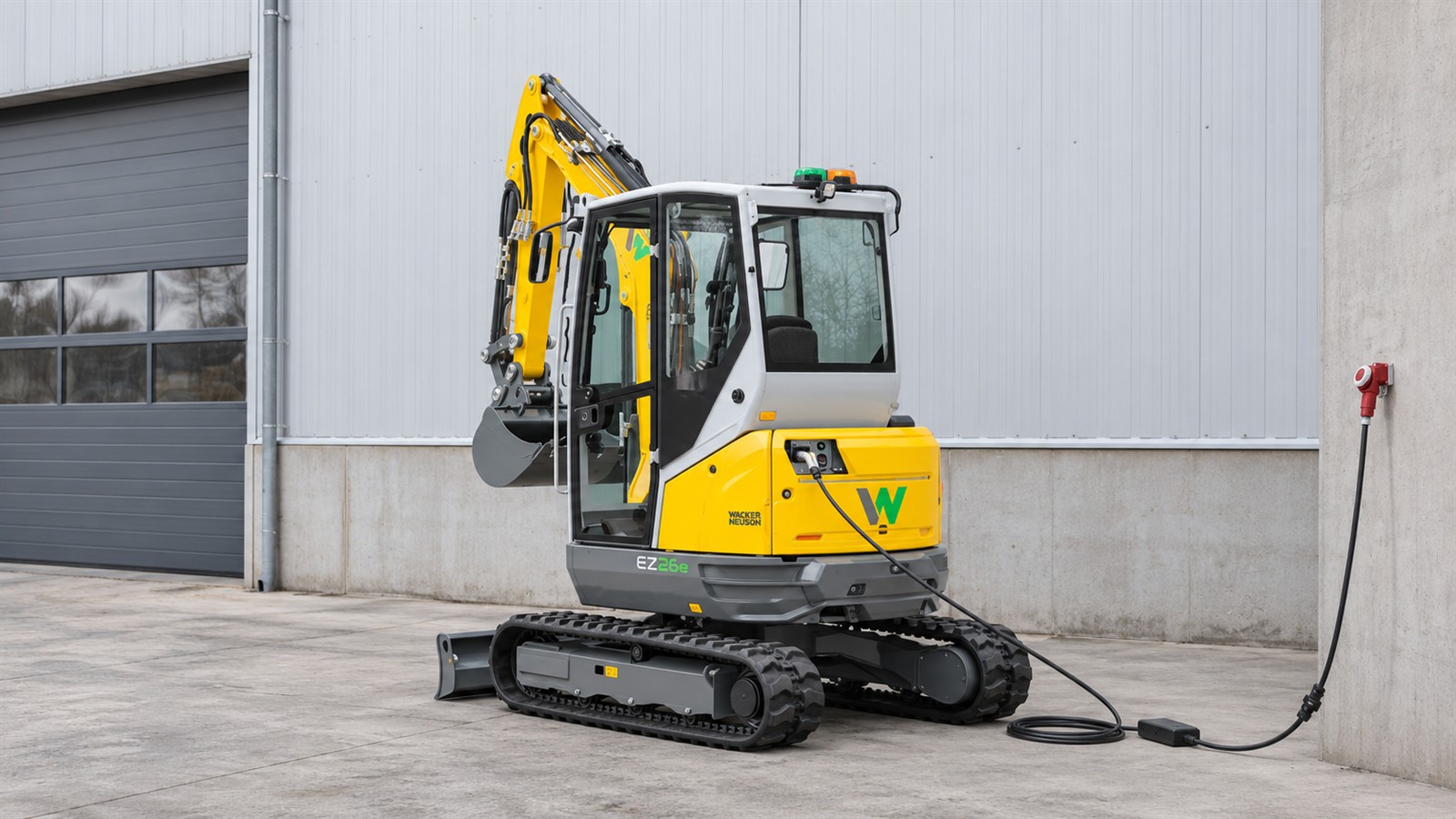
The construction site of the future is developing in several ways: electric drives, digital assistance and autonomous machine concepts. At Wacker Neuson, the EW135 mobile excavator, the EZ26e electric mini excavator and the WL750p and WL950p performance wheel loaders show different focuses. These developments should be evaluated separately: An electric machine does not automatically drive itself, and assistance preparation is not yet an available autonomous work function.
For construction companies, it is therefore less important which future promise sounds the greatest. What is more important is what task a specific machine can perform today, what equipment is supplied and what infrastructure it requires. This overview classifies official manufacturer information and adds practical testing criteria. It is not a separate machine or consumption test.
Wacker Neuson 2026: Distinguishing production models and future concepts
For the Universe 2026 in Hörsching near Linz the manufacturer is naming new machines as well as studies, prototypes and remote-controlled or autonomous concepts. The event took place from September 19th to 24th. This compilation shows different stages of development; It does not provide evidence of the general series availability of all functions demonstrated.
| Topic | Proven focus | What doesn’t automatically follow from this |
|---|---|---|
| EW135 | Mobile excavator with digital operation and assistance preparations | Independent execution of any earthworks |
| EZ26e | Battery electric mini excavator | Autonomous operation without operator |
| WL750p and WL950p | Performance wheel loader with driver assistance | Driverless material handling |
| Autonomous concepts | Development and testing topics | Binding delivery date or universal area of application |
A reliable procurement decision therefore requires a clear status for each function: included as standard, available as an option, prepared or only in development. These four categories should be listed separately in the offer. In this way, today’s benefits can be evaluated without measuring a product exclusively based on possible future expansions.
EW135: Digital operation for sophisticated attachments
The product presentation for autumn 2026 describes a permanently mounted adjustable boom without a swivel console on the EW135, electro-hydraulic pilot control and storable driver or attachment profiles. MiC 4.0 technology and preparations for assistance systems are also mentioned. These are features for operation and integration, not a general promise of autonomy.
For an operation with several tools, it is particularly interesting whether settings can be stored in an understandable manner and can be called up again reliably. The actual attachments used should be used during a demonstration. Document how long it takes to change the settings, which parameters are adjusted and how clearly the active state is displayed.
The vehicle should also be assessed over a complete work period. A precise individual control input does not answer how smoothly driving, positioning, working and tool changing fit together. For a fair comparison, the same material conditions and the same quality of results must apply. Only then will it become clear whether the new operation creates an advantage in your own process.
EZ26e: Electric drive with specific energy requirements
The official EZ26e data mention a 39 kWh lithium-ion battery with 96 volts, up to 9.9 kW onboard charging power and a running time of up to 5.8 hours. The stated charging time from zero to one hundred percent ranges from 4.3 to 18 hours. The manufacturer expressly points out the influence of connection, temperature, task and battery conditions.
These ranges are more important for planning than a single best number. For operations with changing construction sites, it must be clarified which power connection is actually available and how long the machine is standing between uses. The charging power of the machine alone does not guarantee that the construction site connection will provide this power.
Also check the specific equipment. The equipment overview differentiates between standard features and options and lists different loading equipment. Maximum performance on a general data page should therefore not be treated unchecked as part of the scope of delivery of every basic machine. Ask for an offer with a clearly named charger, cable and connection.
This turns battery capacity into a usable deployment plan
A simple model calculation illustrates the principle: If 30 kWh are provided for the planned use of a purely hypothetical machine and the average electrical power consumption is six kW, this results in five hours. With an average of ten kW it would be three hours. This calculation is not an EZ26e measurement; it just shows why the work task is crucial.
For a practical test, the charging status, type of work, active time and breaks should therefore be recorded together. A shift with lots of interruptions is not the same as continuous heavy duty. Heating and other additional consumers also belong in the protocol. This turns a general running time into a realistic estimate for your own construction site.
A buffer is also part of operational planning. A change of vehicle, a late return or an unplanned additional order can shorten the charging time. Therefore, define what residual energy is required for the next use and what alternative exists if the charging point fails. The machine and its power supply should be procured as a common workflow.
Electric means locally without diesel exhaust, not without environmental impact
The EZ26e product page highlights electrical operation and reduced maintenance work on the drive. The immediate advantage is that there are no diesel exhaust fumes at the workplace during battery operation. However, this does not provide a complete statement about the environmental impact of production, electricity provision and overall use.
Similarly, working noises and dust do not disappear automatically. An electric excavator continues to move material and use attachments. When making the deployment decision, the drive and the actual work task should therefore be considered separately. For a cramped living environment, the elimination of the diesel engine can be relevant; the other requirements of the construction site remain in place.
WL750p and WL950p: Assistance for repeated loading cycles
For the new performance wheel loaders, Wacker Neuson describes, among other things, loading assistant, automatic bucket return and lifting height limitation. Such functions support recurring movement sequences. Their benefit depends on how well the work steps match the actual loading goals, material properties and travel routes.
The sensible key figure is therefore the complete loading cycle with the same quality of results. Record pickup, route, drop-off and return. There are also spilled material and necessary corrections. If a function speeds up the movement but causes more rework, the benefit is smaller than the pure cycle time suggests.
A comparison should also be made with the intended operating personnel. An experienced demonstration team and a rotating crew can achieve different results. Good assistance can be explained clearly and used safely even after a break. Comprehensibility and training effort are therefore part of the productivity assessment.
Remote control is a different stage of development than autonomy
With remote control, a person guides the machine from a spatial distance. With assistance, the technology supports certain subtasks. An autonomous system, on the other hand, must plan and carry out actions itself within its intended area of application. The terms describe different distributions of tasks and should be used clearly in offers and demonstrations.
Concrete evidence would be helpful for autonomous concepts: What task is being completed, how is the work area limited, what changes can the machine recognize and when does it need human help? Handling interruptions is equally important. A complete execution with documented interventions says more than a selected successful movement.
No general delivery date for a universally autonomous mini excavator can be derived from the official Universe announcement. If you want to procure such a function, you need a specifically named product with a documented range of functions and operating conditions. A concept shown initially remains an indication of the direction of development.
What construction companies should compare economically
A sensible calculation separates purchases, energy, maintenance and work organization. For an electric machine, this includes charging infrastructure and possible interruptions in use. When it comes to assistance functions, what counts is training and actually usable time savings. For new automation concepts, additional monitoring and support should be explicitly included.
For the combination of machine and tool, our guide to excavators, attachments and amortization deepens this consideration. The decisive benchmark is the same across brands: effort per task completed. Manufacturer information and a real test complement each other instead of replacing each other.
Official presentation of the performance wheel loaders
The following video comes from the official Wacker Neuson channel. It introduces the WL750p and WL950p and illustrates their positioning. The presentation is not proof of driverless operation.
FAQ on the future of Wacker Neuson construction machines
Select a question to open the answer.
Is the electric EZ26e automatically an autonomous excavator?
No. Electric drive and independent task processing are different properties. The product information mentioned does not provide evidence of a general autonomous work function.
Do the best running time values apply to every construction site?
No. Task, temperature, working method and battery conditions influence the running time. A representative test of your own makes sense for operational planning.
Does preparation for assistance mean software that is already available?
No. Preparation, optionally available equipment and activated functions must be shown separately in the specific offer.
When is a new machine function worthwhile?
If it improves your entire workflow and its actual benefits justify the additional costs and organizational effort.
Sources and editorial update
As of: November 7, 2026. The linked official Wacker-Neuson publications and product documents were used. Facilities and offers may vary regionally. The energy bill is its own hypothetical example; a separate practical test was not carried out.