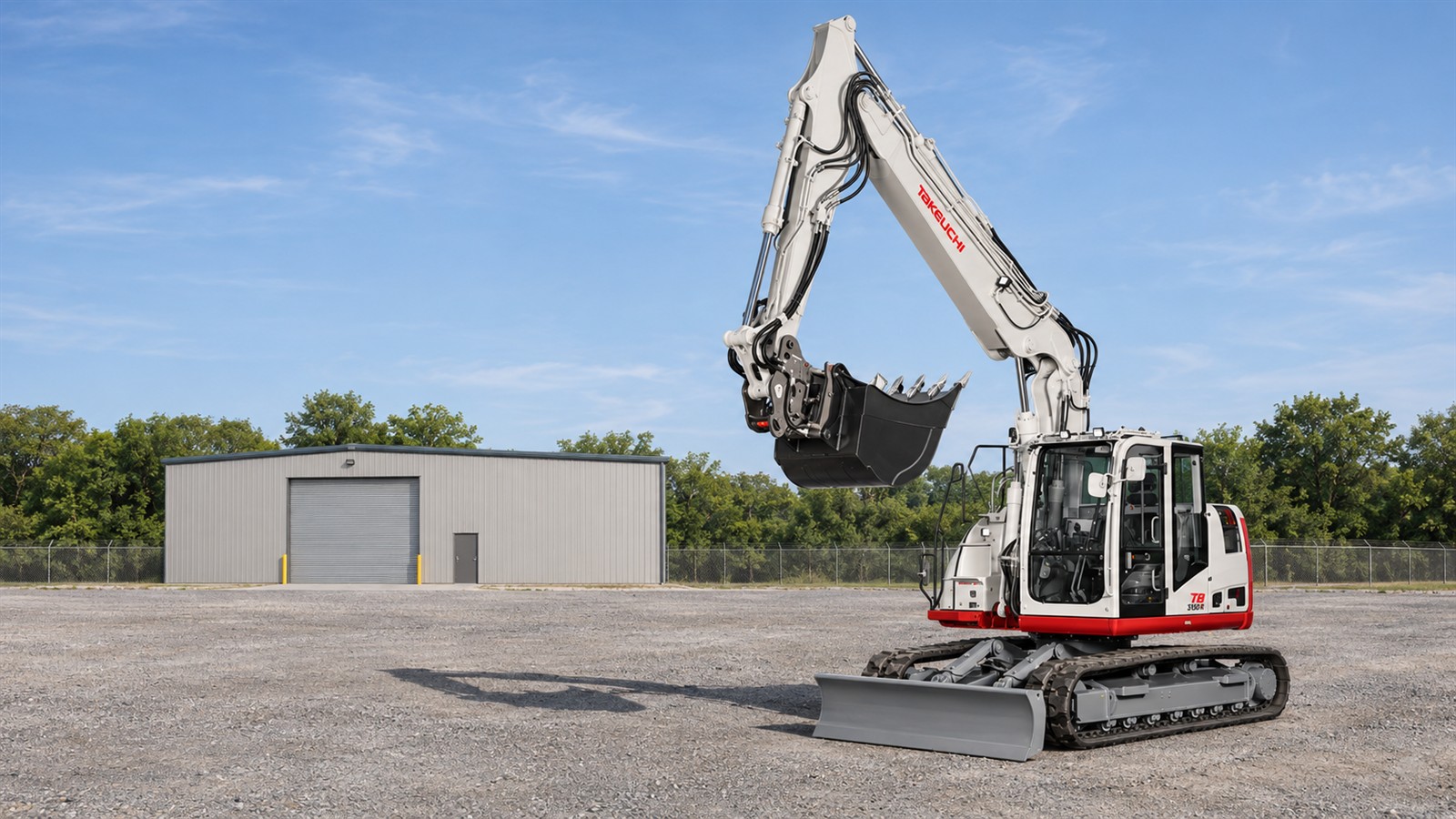
Takeuchi excavators and attachments become economical when the carrier, hydraulics, tool and working process are matched. Engine power alone does not establish that match. What matters is performance at the tool, the complete changeover time and cost per completed job. A breaker, grapple or shear should therefore be assessed as part of a system that includes the coupler, hydraulic connections, operation and maintenance.
This guide explains which specifications matter and how to build a calculation using your own operating data. The current German TB 3150 range provides a machine example, while older TB 2150 documents are identified separately. The financial figures are transparent hypothetical calculations, not measured Takeuchi savings or dealer quotations. German-market specifications should also be checked against the configuration supplied in the customer’s own country.
Measure cost per completed job
The useful comparison is not simply attachment purchase price. It is the total effort required to deliver the same finished result. That might be a defined length of trench, a sorted quantity of demolition material or a completed landscaped area. Unless quality, material and working conditions are comparable, a higher daily output does not establish which combination is more economical.
Record productive work, attachment changes, repositioning, waiting and finishing work. Add transport, fuel, wear and any support from other employees. An attachment can complete its immediate operation faster while performing worse overall if it requires additional setup or transport. Evaluating the complete process prevents a local improvement from being mistaken for a better business result.
Keep TB 3150 and TB 2150 specifications separate
The current German TB 3150 R CM/R CV page lists 85 kW engine power and three simultaneously controllable auxiliary circuits. CM denotes the mono-boom version and CV the adjustable-boom version. The supplier describes adjustable auxiliary pressure and flow. These statements concern the identified model and do not replace inspection of the actual equipment supplied.
The older TB 2150 R brochure instead lists four controllable auxiliary circuits and up to 224 litres per minute in its specified high-flow mode. Those figures should not be transferred to another range without confirmation. For a used machine, build year, installed equipment and subsequent modifications also matter. Obtain documentation for the individual machine being offered.
Match hydraulic pressure, flow and return requirements
Each hydraulic attachment needs a clear interface specification: permissible operating pressure, required flow, return requirements and, where applicable, a case-drain line. Connection sizes and control functions belong in the same record. A carrier’s maximum pump-flow figure does not by itself establish the power available to the tool under actual working conditions.
A basic physical relationship helps put numbers in context: hydraulic power in kW equals pressure difference in bar multiplied by flow in litres per minute, divided by 600. At an assumed pressure difference of 180 bar and 90 litres per minute, the result is 27 kW. This is an idealised calculation without efficiency losses, not a performance specification for a particular Takeuchi attachment. Engine output, pump output and useful tool power are different quantities.
Pressure loss deserves attention. An assumed 20-bar loss at 90 litres per minute represents three kW that does not become the intended tool work. Hoses, line sizes, couplings and return paths therefore need to be considered together. A larger coupling does not remove a restriction elsewhere. Likewise, separate maximum pressure and maximum flow ratings should not be combined into an operating point that has not been confirmed for the system.
TAKLOCK, attachment locking and fully hydraulic changeover
A hydraulic quick hitch and a hydraulic line coupling perform different jobs. The hitch locks the attachment to its mounting interface; a coupling connects hydraulic lines. A fully hydraulic overall system also automates the service connections during changeover. Which steps can be performed from the cab depends on the chosen combination rather than the general product label.
The TAKLOCK product page describes combined connection of hydraulic lines and connection of suitable tools with residual pressure. It lists different versions and port arrangements. Depending on version, the published limits reach 260 litres per minute per relevant main connection and 450 bar. These are not universal ratings for every coupling or the entire attachment.
The separate hydraulic quick-hitch page describes controlling the attachment mounting connection from the cab. A quotation should therefore itemise the mounting interface, lock, hydraulic coupling, electrical connection and attachment adapters. Otherwise, prices for systems offering different functions can appear directly comparable when they are not.
Calculate the payback from faster changes
The example below considers only the value of reduced changeover time. Assume six complete attachment changes per working day, four minutes saved per change and 180 relevant operating days a year. That releases 72 hours annually. At an internally assigned value of €100 per hour, the gross annual benefit is €7,200.
Assume an additional investment of €8,000 and extra annual maintenance of €300. The resulting modelled annual benefit is €6,900, giving a simple payback of about 1.16 years. Financing, residual value, taxation and discounting are excluded from this simplified calculation. The amounts are not market prices or a savings guarantee from the manufacturer.
| Changes per operating day | Hours released annually | Gross annual benefit | Simple payback* |
|---|---|---|---|
| 2 | 24 h | €2,400 | About 3.8 years |
| 6 | 72 h | €7,200 | About 1.2 years |
| 10 | 120 h | €12,000 | About 0.7 years |
*Assumptions: four minutes saved per change, 180 operating days, €100/hour time value, €8,000 additional investment and €300 additional annual maintenance. Formula: additional investment / [(annual hours saved × hourly value) − additional annual costs].
The crucial issue is whether released time can be used economically. If the next trade is unavailable or staffing costs remain unchanged, a time saving does not automatically create an equivalent cash saving. A conservative model can apply a utilisation factor. If only 70 percent of the time value is realised, the middle example produces €4,740 after extra maintenance, extending simple payback to about 1.7 years.
The hourly value should also avoid double counting. If it already includes operator and machine costs, adding those costs again inflates the benefit. A contractor should decide whether the calculation represents avoided expenditure, additional usable capacity or a combination of both, and then apply consistent assumptions throughout.
Choose attachments around the actual workload
Start with the job rather than the catalogue. Repeated excavation calls for suitable bucket geometry; changing materials may justify grapples and sorting tools. Breakers, compactors and shears each require their own hydraulic and mechanical match. A rarely used specialist tool may be more economical to rent than to keep as an underutilised owned asset.
The German breaker overview gives a specific example: the TNB-7J is listed at 950 kg, requiring 80–120 litres per minute and intended for a 15–16-tonne machine class. That is a screening aid, not automatic approval for every machine of similar weight. Mounting, equipment and the permitted combination still need individual confirmation.
A short requirements sheet improves quotations. Record the material, target output, available working space and expected annual utilisation. Add wear parts, service access and transport requirements. This creates a more useful basis for selection than asking for the most powerful attachment. The goal is suitable performance for the jobs that actually recur.
Assess attachment mass, reach and load capacity together
The equipment being moved includes more than the breaker or grapple. A quick hitch, tiltrotator or tilting unit and additional adapters form part of the combination. A loaded grapple also carries material. Every extra component changes the setup, so actual equipment and applicable manufacturer information matter more than nominal excavator weight alone.
Reach figures should not simply be added. Boom reach plus attachment length does not establish a universally usable working reach with unchanged capacity. Geometry, working position and operating limits must be considered together. Obtain documentation for the proposed configuration and its permitted working envelope, especially when a long specialist attachment substantially changes the usual geometry.
Include emissions and the workplace in the cost model
Modern exhaust aftertreatment is not blanket evidence of suitability for every indoor application. Germany’s BG BAU explains issues relating to engine exhaust. Enclosed or partly enclosed workplaces require assessment of their actual conditions and appropriate measures. An emissions-stage label does not replace that assessment; customers elsewhere must consider their own local requirements.
This also affects commercial planning. Ventilation, alternative power, work organisation and possible restrictions belong in the site setup budget before the equipment is chosen. Discovering these items afterwards can eliminate an apparent price advantage. Suitability for the workplace is therefore part of configuration alongside hydraulic compatibility.
Official TAKLOCK demonstration
The following video is from the official Takeuchi Baumaschinen channel and is linked from the TAKLOCK product page. It illustrates the coupling principle. A contractor should measure actual changeover time on its own complete attachment combination.
Turn a demonstration into a useful operating trial
Measure several complete changes under comparable conditions. Include parking the tool, releasing and connecting it safely, the prescribed checks and resumption of work. Do not compare one system’s coupling movement with another system’s entire changeover. Record any steps that require a second person as well.
Then complete a representative work section and measure output, fuel and finishing work. Half a day of ordinary tasks can be more informative than one spectacular movement. Those observations support comparison of both a purchase quotation and a rental alternative. The most economical combination is the one that reliably completes the contractor’s own job with the lowest total effort.
FAQ about Takeuchi excavators and attachments
Select a question to open the answer.
Is TAKLOCK the same as a fully hydraulic quick hitch?
No. Hydraulic line connection and mechanical attachment locking are different functions. The quotation must identify which steps the particular overall system automates.
Is engine power enough to select an attachment?
No. Flow, pressure, return requirements, controls, mass and mounting must match the permitted configuration.
When does a hydraulic coupling pay for itself?
When enough economically useful changeover time is saved to cover additional investment and running costs. Frequency, the complete process and utilisation determine the outcome.
Can TB 2150 specifications be used for a TB 3150?
No. Model, version and actual equipment must match. The documents compared here already differ in their auxiliary-circuit descriptions.
Sources and editorial date
Updated 7 November 2026. Sources are the linked German Takeuchi product documents supplied by Wilhelm Schäfer and BG BAU information. All financial examples are original model calculations. No hands-on machine or fuel-consumption test was performed.