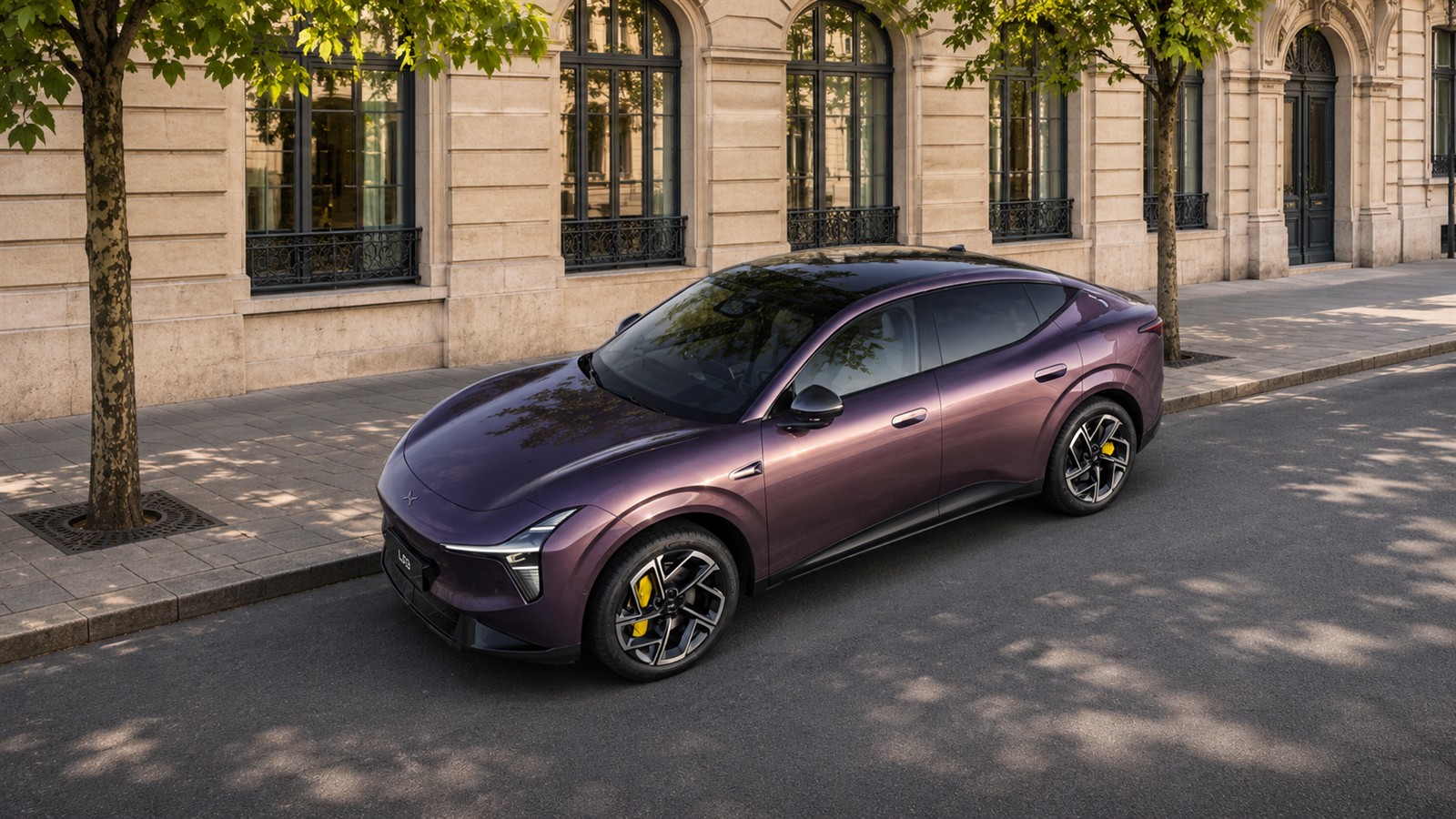
The XPENG L03 combines a German starting price of €35,600 with electric powertrains and a broad range of parking functions. For urban users, however, the practical questions go beyond the equipment list. How easy is a 4.65-metre vehicle to position, which parking features belong to the selected version, and what does its published electricity consumption tell you about daily short journeys? A new model requires a clear distinction between preliminary specifications, promised software and measured experience.
This guide draws on XPENG’s German model page, configurator and launch announcement. It is not a first-hand road or parking test. That distinction keeps the evidence clear: manufacturer specifications establish what has been announced, while a representative test drive is needed to assess the individual user’s experience. The focus here is parking assistance, urban energy use and the differences that matter when choosing a version.
XPENG L03 dimensions and German pricing
The German XPENG model page lists a length of 4,650 millimetres, a width of 1,920 millimetres and a height of 1,600 millimetres. The wheelbase measures 2,850 millimetres. This five-seat SUV coupe is therefore not a small city car, even if its assistance technology aims to simplify urban use. Narrow residential streets and older multistorey car parks still impose physical limits that software cannot remove.
Do not assume that the quoted body width is the total width with mirrors extended. A narrow garage needs a real clearance check that includes mirrors and enough space to open a door. Automated steering can help position a vehicle, but it cannot widen a garage entrance or create room for passengers to get out. These basic geometric requirements can matter more than the name of a sophisticated parking mode.
XPENG advertises a starting price of €35,600 including German VAT. Its 16 July 2026 launch announcement scheduled initial customer deliveries for the fourth quarter of 2026. An announced delivery window is not proof that every configuration is immediately available from every dealer. Before ordering, obtain the actual price, additional charges, included equipment and a credible delivery estimate for the vehicle you want.
Key figures for the battery-electric entry version
The German configurator lists a 58.3 kWh gross LFP battery, 180 kW output and 264 Nm of torque for the L03 RWD Standard. It also quotes 445 kilometres of WLTP range and electricity consumption of 15.3 kWh per 100 kilometres. Crucially, the accompanying disclaimer identifies consumption, emissions and range figures as preliminary and not yet backed by final binding type approval.
| Item | L03 RWD Standard, manufacturer figures |
|---|---|
| Battery | 58.3 kWh gross, LFP |
| Powertrain | Rear-wheel drive, 180 kW, 264 Nm |
| Range | 445 km WLTP, preliminary |
| Electricity consumption | 15.3 kWh/100 km, preliminary |
| DC charging | Up to 193 kW; 10–80% in 20 minutes according to XPENG |
| AC charging | 11 kW |
| Turning circle | 10.5 m |
| Storage | 367 litres at the rear, 89 litres at the front |
These figures belong to that particular version. The configurator also lists RWD Long, AWD Performance, AWD Performance Ultra and PowerX Long. PowerX uses a range-extender powertrain and should not be treated as an identical battery-electric configuration when comparing energy use. Equally, the performance figures of a more powerful all-wheel-drive version should not be presented alongside the entry model’s price as though they describe one vehicle.
Why WLTP consumption is not an urban road-test result
WLTP provides a standardised basis for comparison. It does not promise that every city journey will produce the same number. In the L03’s case, the published figures also carry the manufacturer’s preliminary-status warning. A careful comparison therefore records that qualification and checks the final figures for the actual specification being ordered when those become available.
Low urban speeds and regenerative braking can favour an electric vehicle. Short journeys can work in the opposite direction because cabin heating, air conditioning and temperature management account for a larger share of the total energy. A cold start followed by a very short trip may produce a high value when expressed per 100 kilometres. Temperature, time parked, elevation changes, tyres and the number of stops all belong in a useful consumption record.
A deliberately simplified example illustrates the arithmetic. Suppose an electric vehicle uses three kWh for the driving portion of a 20-kilometre trip and a further one kWh for ancillary loads. Its total is four kWh, equivalent to 20 kWh per 100 kilometres. Without that additional one kWh, the equivalent would be 15 kWh per 100 kilometres. This is a hypothetical calculation, not an L03 measurement and not a temperature-specific prediction.
The measurement boundary matters too. An in-car consumption display and a meter at the charging point do not necessarily record identical amounts of energy, because charging can introduce additional losses. To estimate actual electricity costs, record energy drawn from the charger and distance travelled across several comparable charging cycles. A single short trip showing an attractive dashboard value is not enough to establish an ownership cost.
How to make an urban test drive more useful
Begin with a simple protocol: the same route, a similar traffic period, a recorded outside temperature and a comparable starting condition. Set climate control to a level you would actually use. Switching it off solely to obtain the lowest possible number makes the result less relevant if you will normally drive with heating or cooling. The purpose is to represent your routine rather than produce a record figure.
Record distance, driving time, average speed, starting and finishing readings, and any unusual events. Where possible, repeat the route in different temperatures and distinguish a cold short trip from a journey in an already conditioned vehicle. This improves the comparison without pretending to replace a controlled laboratory procedure. Note the version and tyres as well, so that differences between vehicles do not get attributed incorrectly to software or driving style.
For a commuter, repeated results on the actual daily route can be more informative than a generic urban label. A route with a long congested section differs from a short suburban run followed by parking. Establish which pattern matches your use, then assess the numbers in that context. The charging arrangement at home or work also affects convenience even when the vehicle’s driving consumption is unchanged.
What the L03 parking assistant is advertised to do
XPENG lists a 360-degree camera view, ultrasonic sensing and APA automated parking assistance in its configurator. Remote parking functions and smartphone-controlled forward or backward movement also appear, with the exact scope depending on version and feature availability. These terms refer to different operating procedures. The broad phrase parking assistant does not establish that every version can handle every space without supervision.
Ask the dealer to demonstrate the specific feature on the vehicle under consideration. Which spaces can it recognise, who must monitor the surroundings, and how is the manoeuvre stopped? For remote operation, the current manual’s requirements are particularly relevant. A sales description does not replace those instructions or establish that a promised function has already been activated on the individual car.
Repeatable tasks make a demonstration more informative: a clearly marked perpendicular bay, a sufficiently large parallel space and an exit manoeuvre under comparable conditions. Record correction movements, time taken and any required intervention. More difficult scenarios should only be attempted within the manufacturer’s operating conditions and with safe clearance from people and objects. People must never be used as collision-test obstacles.
Turning circle, visibility and interface still matter
The quoted 10.5-metre turning circle is a diameter, not a radius. It describes a different property from the ability to detect a parking space. A vehicle with a useful turning circle can still require several movements in a particular garage because the approach, pillars, overhangs and desired final position all interact. Assistance does not remove those physical constraints.
A camera system can improve orientation, but practical usefulness depends on the displayed view and how clearly the surroundings can be understood. During a demonstration, check how quickly the required view can be selected and whether it remains understandable in typical lighting. For daily use, clear and predictable operation may be more valuable than an extensive menu of additional modes that are awkward to access.
Future assistance is different from equipment available today
For the AWD Performance Ultra, XPENG lists additional capabilities and describes city and motorway NGP as planned for the first quarter of 2027. That date is after this article’s editorial cutoff. It must therefore be treated as an announcement, not an already activated function or a capability of every L03. Regional conditions and the exact vehicle configuration also need to be checked.
Similarly, the entry version’s adaptive cruise control and lane-centring features do not make it an autonomous urban vehicle. Driving assistance, parking assistance and planned navigation-related capabilities perform different tasks. When comparing prices, separate equipment that can be demonstrated now from later software additions. That makes it possible to judge an upgrade against benefits that are actually available rather than combining several future expectations.
Official XPENG L03 product video
The following presentation is published by XPENG’s official channel. It introduces the model and its positioning. As manufacturer material, it does not replace an independent energy-consumption test or verification of the current German equipment specification.
FAQ about XPENG L03 parking and city consumption
Select a question to open the answer.
How much does the XPENG L03 cost in Germany?
XPENG quotes a starting price of €35,600 including German VAT. Check the individual offer for the selected version, options, additional charges and delivery conditions before making a direct price comparison.
What is its real city electricity consumption?
This article does not contain a first-hand city measurement. XPENG quotes a preliminary WLTP figure of 15.3 kWh per 100 kilometres for the RWD Standard. Short journeys, temperature and ancillary loads can materially change actual urban consumption.
Does every version include every parking feature?
No universal assumption should be made. Verify the selected equipment and current software. APA, smartphone manoeuvring and additional parking modes should be assessed separately and demonstrated on the actual vehicle.
Is city and motorway NGP already available?
The configurator assessed here describes those functions for the AWD Performance Ultra as planned for the first quarter of 2027. At the 4 November 2026 editorial cutoff, that is a future announcement rather than a confirmed present production feature.
Sources and editorial date
Updated 4 November 2026. Sources are the linked German XPENG model page, configurator and official launch announcement. Preliminary specifications, delivery information and planned software functions may change before the final vehicle configuration is established.