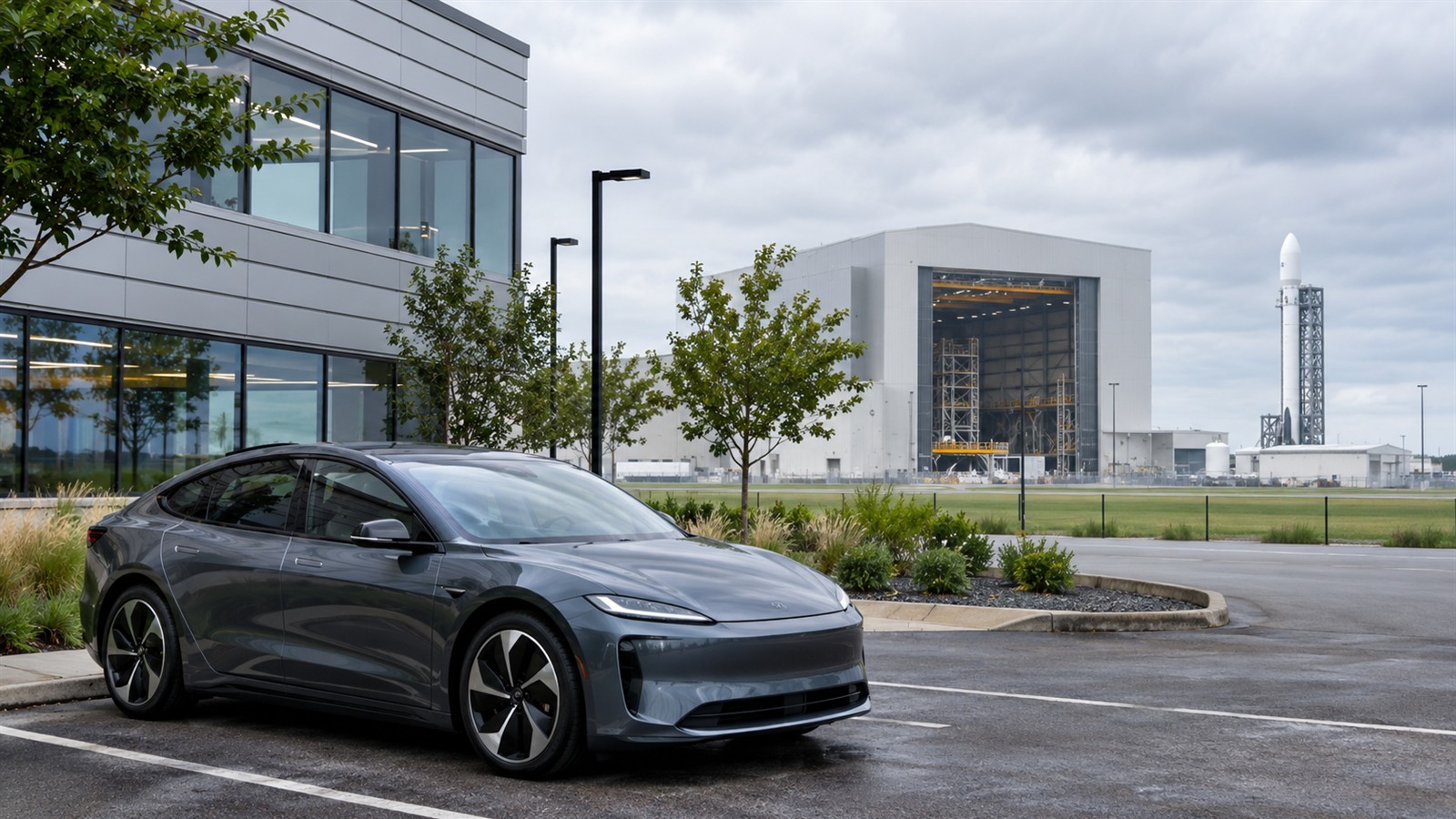
A merger of Tesla and SpaceX is being formally examined, but has not been agreed. For an industrial assessment, the terms of a potential transaction now matter: what benefits would actually arise, how would the companies be valued, and how would each group of shareholders’ interests be protected?
Combining electric mobility, spaceflight, energy and artificial intelligence suggests a vast shared technological world. A corporate merger must nevertheless offer more than a compelling story. It would need to create benefits that normal supply agreements or partnerships could not achieve equally well. This article separates confirmed developments from possible consequences and explains the economic questions behind the decision. Updated: 4 November 2026.
Tesla–SpaceX merger: what is officially confirmed?
In its quarterly report filed on 22 October 2026, SpaceX states that its board formed a special committee to examine a possible combination with Tesla. Tesla had also established such a committee. SpaceX explicitly emphasises that its own committee has not yet made a decision and that neither an agreement nor completion of a transaction is assured. The report refers to the announcement during the earnings presentation on 20 October. Source: SpaceX, Form 10-Q, section on the possible combination with Tesla.
This is a concrete step beyond general speculation. It is not, however, a published merger agreement. No exchange ratio, binding completion date or final structure of a combined company can be inferred from it. Each subsequent report should therefore be judged on whether it documents a new decision or merely describes expectations surrounding the same review process.
An existing investment is not a complete merger
Tesla’s 2026 annual-meeting materials already describe a financial connection. Following SpaceX’s acquisition of xAI Holdings, Tesla’s originally intended xAI investment was converted into a right to SpaceX shares. Tesla states that it completed an investment of approximately US$2 billion in SpaceX Class A shares on 12 March 2026. The documents also describe existing business relationships between the companies. Source: Tesla, 2026 Proxy Statement, Related Person Transactions.
A minority investment and a complete combination have different consequences. With an investment, the companies generally remain separate organisations with their own results and obligations. A merger could substantially change ownership rights, decision-making and the allocation of economic risks. Existing cooperation is relevant background, but does not replace an assessment of the additional benefit of closer integration.
Why combined market values are not a transaction price
Very large combinations quickly generate headlines with impressive totals. Adding two market capitalisations at a particular moment initially describes only a mathematical snapshot. It does not mean that amount will be paid or become available as fresh liquidity. Share prices can change, and the specific transaction structure remains a separate question.
In a share exchange, the proportion subsequently held by existing owners is especially important. The same industrial plan may be more or less attractive to different shareholder groups depending on the exchange ratio. Looking only at the resulting group’s size is therefore insufficient. The allocation of value and risk is inseparable from the assessment.
A simple thought experiment illustrates this: two arbitrary companies expect combined annual benefits of €100 million. If integration costs €400 million upfront, several years are needed just to offset those outlays arithmetically. The example is illustrative, not a forecast for Tesla or SpaceX. It shows why timing, investment requirements and achievable savings must be assessed together.
Which industrial synergies could be plausible?
Joint procurement, standardised infrastructure or shared development can in principle offer benefits. Technology-driven companies also bring expertise in software, power electronics and complex manufacturing. Whether this produces actual savings depends on how similar the required services really are and whether their use can be reconciled organisationally.
A high need for computing power, for example, does not mean that every application can use the same systems. Availability requirements, data access, locations and internal priorities may differ. Shared resources therefore need planning and pricing. Otherwise, it is difficult to establish which business benefits and which bears the costs.
The same applies to industrial experience. The ability to manufacture a product at scale is valuable, but cannot be transferred unchanged to every other product family. Different requirements for quality, documentation and support remain. A strong merger rationale would therefore need to identify concrete shared tasks, rather than simply juxtapose similar technological buzzwords.
Why cooperation remains an alternative in its own right
Companies can purchase services from one another without merging completely. Supply agreements, joint development projects or clearly limited investments enable different forms of cooperation. The appropriate structure depends on the rights, investments and responsibilities required. A merger is only one possible organisational response.
Comparing such alternatives is therefore economically relevant for the special committees. If a benefit could already be achieved through arm’s-length contracts, a merger must create additional value. At the same time, closely interconnected tasks may benefit from common management. The decision requires a concrete trade-off; general enthusiasm for the same future technologies is not enough.
Elon Musk and the question of independent decisions
When companies share an important executive or significant owners, managing conflicts of interest deserves particular attention. An economic assessment needs to establish whether both companies’ interests are examined transparently. This covers valuation, negotiations and the treatment of existing business relationships. A convincing industrial idea does not automatically resolve these governance questions.
Readers should distinguish personal support for a proposal from a binding decision by the responsible bodies. Likewise, not every public statement about possible votes is a final transaction condition. The actual published resolutions and agreements would be decisive. Until those exist, precise statements about the final process remain provisional.
What a potential merger would mean for suppliers and customers
Larger combined purchasing volumes could create opportunities for suppliers. Contacts, contractual terms and internal approvals might also change. Whether this produces more business in a particular case depends on each division’s needs. Group size alone guarantees neither additional orders nor better payment terms.
Customers primarily care about reliable products and support. A combination should not lose sight of ongoing obligations. New joint projects absorb management capacity while existing services must continue. Integration planning therefore belongs in the industrial assessment alongside potential future businesses.
The next substantive development would be an officially documented further step with clear terms. Until then, the Tesla–SpaceX merger can be described as under review. Whether it happens and creates economic value remains open. Our article on the expansion of Gigafactory Grünheide provides a complementary look at actual industrial capacity.
FAQ: the possible Tesla–SpaceX merger
Select a question to open the answer.
Have Tesla and SpaceX already merged?
The official documents assessed here confirm a review by special committees. They do not establish a completed combination. SpaceX explicitly notes that the outcome remains open.
Does Tesla already hold a stake in SpaceX?
Yes. Tesla’s 2026 annual-meeting documents describe completion of an approximately US$2 billion investment in SpaceX shares on 12 March 2026. This must be distinguished from a complete merger.
Why is the sum of market capitalisations not a purchase price?
It is a share-price-dependent snapshot. The actual economic exchange would depend on the agreed transaction structure and, where applicable, the share exchange ratio.