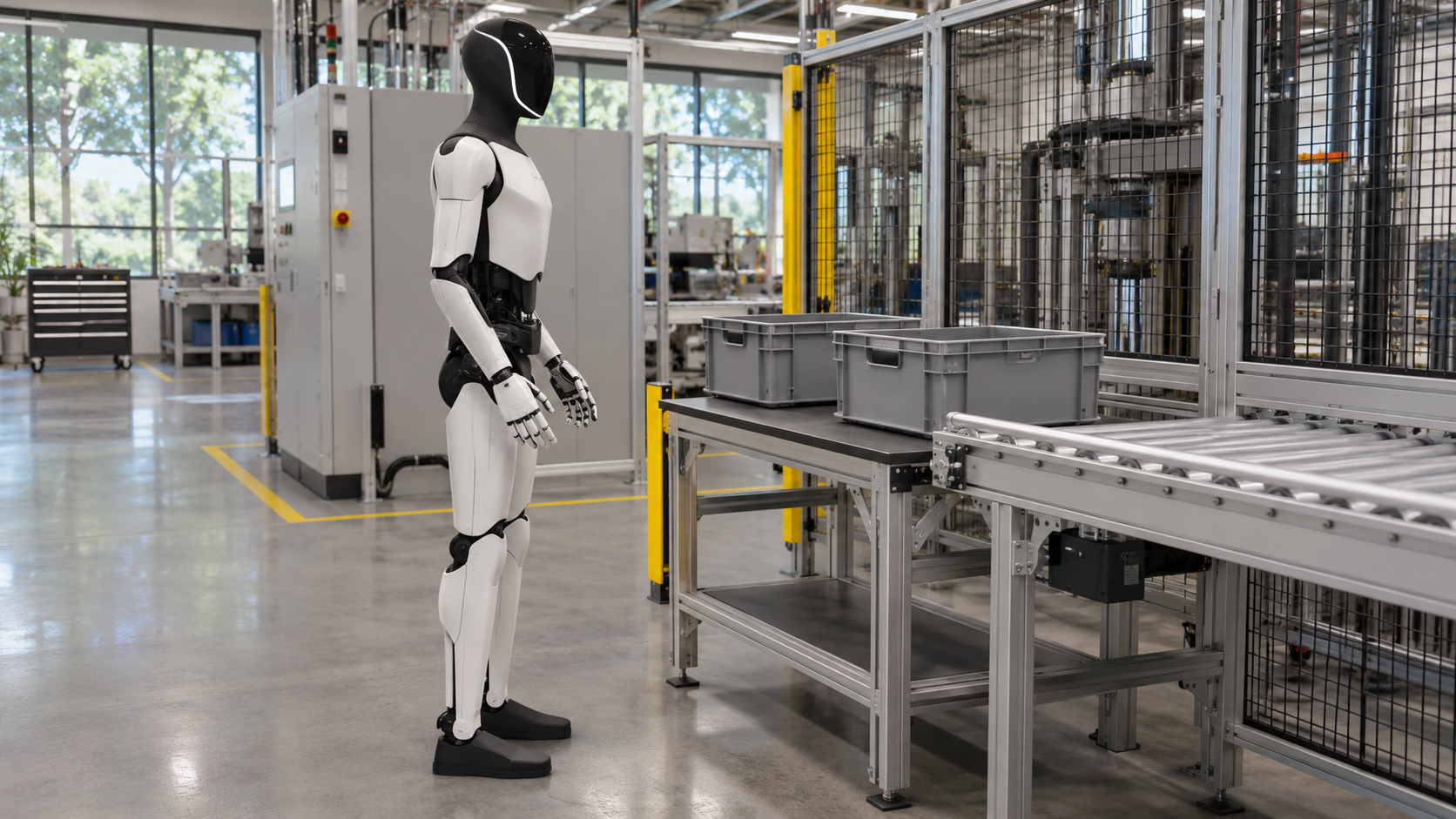
The first robot on a new production line attracts attention. A production manager is more interested in whether it still completes useful work three months later. That is where Tesla Optimus becomes an industrial story: can a humanoid development project become equipment that fits an existing operation and justifies the effort of running it?
The decisive demonstration starts at the handoff between two work steps. What matters there is the correct component, a dependable time and an understandable response to a deviation. A company considering Optimus can turn those requirements into an evaluation plan. It starts with the job and ends with responsibility for continuing operation.
What Tesla reports, and what a plant must establish
Tesla’s Q3 2026 update reports Optimus production in Fremont, listing California as an early ramp and Texas as construction. Tesla’s quarterly update.
That is a relevant manufacturing milestone. Equipment selection then needs further answers: which process is supported, what environment does the supplier require and what performance is offered in the contract? A public announcement and a customer’s requirements document serve different purposes. Connecting them carefully allows a buyer to recognise progress while setting precise expectations.
Tesla describes Optimus as a general-purpose humanoid for unsafe, repetitive or boring work. Tesla’s robotics page. Inside a plant, that objective should first become one specific task. “Provide materials” leaves too much open. A planning brief could instead specify moving defined components from a particular container to an agreed handoff position and confirming completion. This is a proposed application description, not an established Optimus capability.
Evidence one: it fits the material flow
One successful grasp may accomplish little at a badly designed handoff. If the container arrives late or the next station cannot receive the part, waiting replaces useful output. Before purchasing, I would map the material’s journey from input to accepted output. Each transition needs an identifiable release signal and somebody responsible for deciding what happens after an interruption.
Alternatives belong in the same discussion. A different cart, a simple gripper or a better arrangement of components might solve the problem. A humanoid should make its case where its mobility provides a clear benefit for the actual job. A general desire to innovate does not supply that explanation. Our article on open-source robots and different platform concepts provides another perspective on choosing an approach.
Evidence two: quality is defined before the trial
An acceptance test needs an unambiguous definition of success. Is placing a part within an area sufficient, or must its position meet a specific tolerance? Who evaluates damaged packaging? Which deviation stops the process? These decisions should precede the trial, so an attractive demonstration cannot quietly replace the original requirement.
I would prepare normal cases together with selected deviations: a rotated container, a missing component or an unavailable downstream station. These are suggested test cases. Only an actual trial can establish which ones the offered system handles. Record all attempts, including resets and rejected outputs, rather than selecting only the completed sequences. The resulting evidence is much more useful when discussing the next stage.
Evidence three: interruptions remain understandable
For a shift operation, an understandable pause can be more useful than an unclear attempt to continue. An operator needs to know why the machine is waiting, which action is permitted and what enables a restart. Planning this in advance prevents responsibility from drifting between production, maintenance and the supplier while the workstation remains stopped.
A shared event record could note task start, object pickup, handoff request, assistance request and completion. It need not become a detailed record of individual workers. The purpose is to connect waiting and intervention to a cause. Otherwise a team may not know whether the robot, the material supply or a missing approval limits the process.
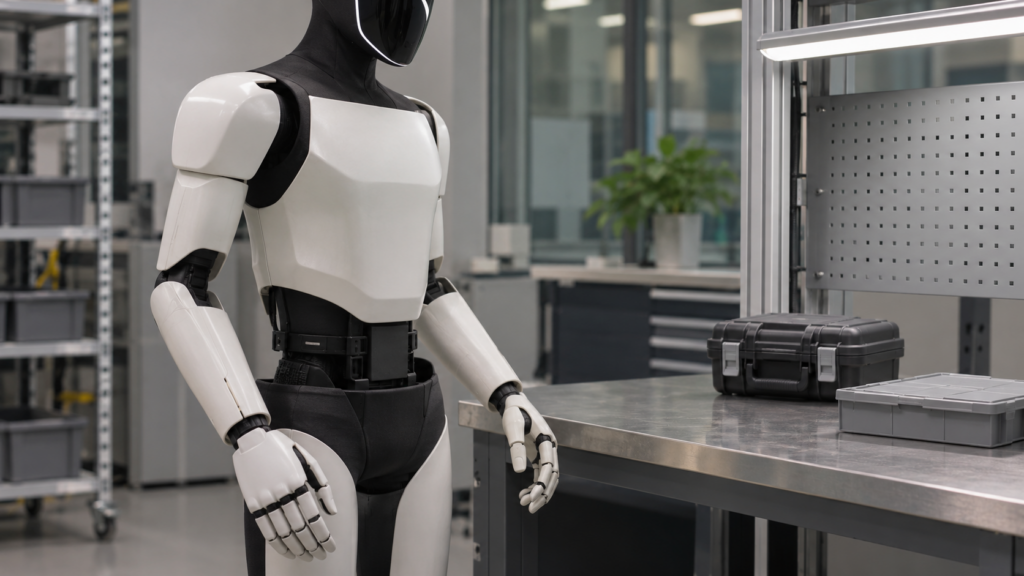 [Bild mit Hilfe von KI bearbeitet]
Evidence four: the economics survive a difficult week
A hypothetical calculation explains why cycle time is insufficient. Suppose a plant expects 1,600 productive hours each year and budgets €32,000 annually for the whole installation. That is €20 per productive hour. If interruptions reduce useful operation to 800 hours, the figure doubles. These are freely chosen assumptions, not Tesla prices or measured Optimus performance.
Total costs should include workplace preparation, training, ongoing assistance and any fallback arrangement alongside a purchase or lease payment. The plant also needs to identify a benefit it can actually realise. Does the installation relieve a bottleneck? Can a person move to other necessary work? Or does staffing remain unchanged? A technical improvement becomes a meaningful operating calculation only when those consequences are understood.
Alpha Bionic examines the wider commercial opportunity in its English analysis of Optimus and Tesla’s car business. Here, the practical engineering question is how a plant can assemble the task, conditions and support into an investable application. The two perspectives complement one another without making a market forecast an acceptance criterion.
Evidence five: maintenance and changes have owners
A pilot does not end after the first successful working day. Who orders wear parts, who can install software updates and who approves the process after a replacement? Settle these questions before handing the installation to regular production. What appears to be a small supplier update can still require the customer to evaluate its effect on a particular workflow.
I would keep the task description, software version, approved settings and support contacts together. This makes two trials easier to compare. A deputy should also know how to report a fault. A project that depends entirely on one enthusiastic specialist is difficult to transfer to additional shifts or another location. Operational knowledge has to belong to the team.
The hand connects the whole application
Grasping brings together material, perception, movement and quality requirements. For an operator, the relevant result is what happens to the actual part, rather than the number of gestures a hand can make. How is an uncertain grasp recognised? Can a damaged contact surface be replaced quickly? What check follows the replacement? The offered application must answer these questions; a convincing appearance cannot.
Tesla’s involvement in large industrial projects makes the topic interesting, but it does not automatically settle a customer’s application. Our coverage of production and expansion at Grünheide addresses another aspect of industrial scaling. Capacity, achieved throughput and dependable operation are separate things to examine when introducing equipment.
A pilot should lead to a decision
A good trial need not answer every question forever. It should enable a clear next decision: continue, narrow the task, change the workstation or stop. That requires criteria agreed beforehand and a person responsible for making the decision. The project becomes easier to assess when the team can explain why the next step follows from the evidence.
Optimus could substantially change the automation discussion. A production site, however, gains value through a sequence of small, verifiable handoffs. When those work reliably and the support burden and costs remain manageable, the larger industrial promise acquires a practical foundation.
FAQ: evaluating Optimus as industrial equipment
Select a question to open the answer.
Does production start prove suitability for my factory?
It establishes a manufacturing step for the supplier. Suitability needs assessment against the offered task, local conditions and an agreed acceptance process.
Which task makes a useful first trial?
A bounded activity with known inputs and a verifiable output. Waiting states and the people responsible for them should also be clearly described.
How can human assistance be counted fairly?
Record interventions and the time involved, then include them in staffing and cost calculations. Assistance can be a sensible part of the operating concept.
What should accompany the cycle-time figure?
The amount of accepted output across the full evaluation period. Together with costs and interventions, it shows whether the process actually improved.
When should a pilot stop?
When agreed requirements remain unmet and there is no credible adjustment. Establish stopping criteria before the trial begins.
Do the images show real Optimus deployments?
They are new AI illustrations based on Optimus’s public design. They illustrate industrial evaluation scenes rather than documenting a Tesla installation or verified capability.