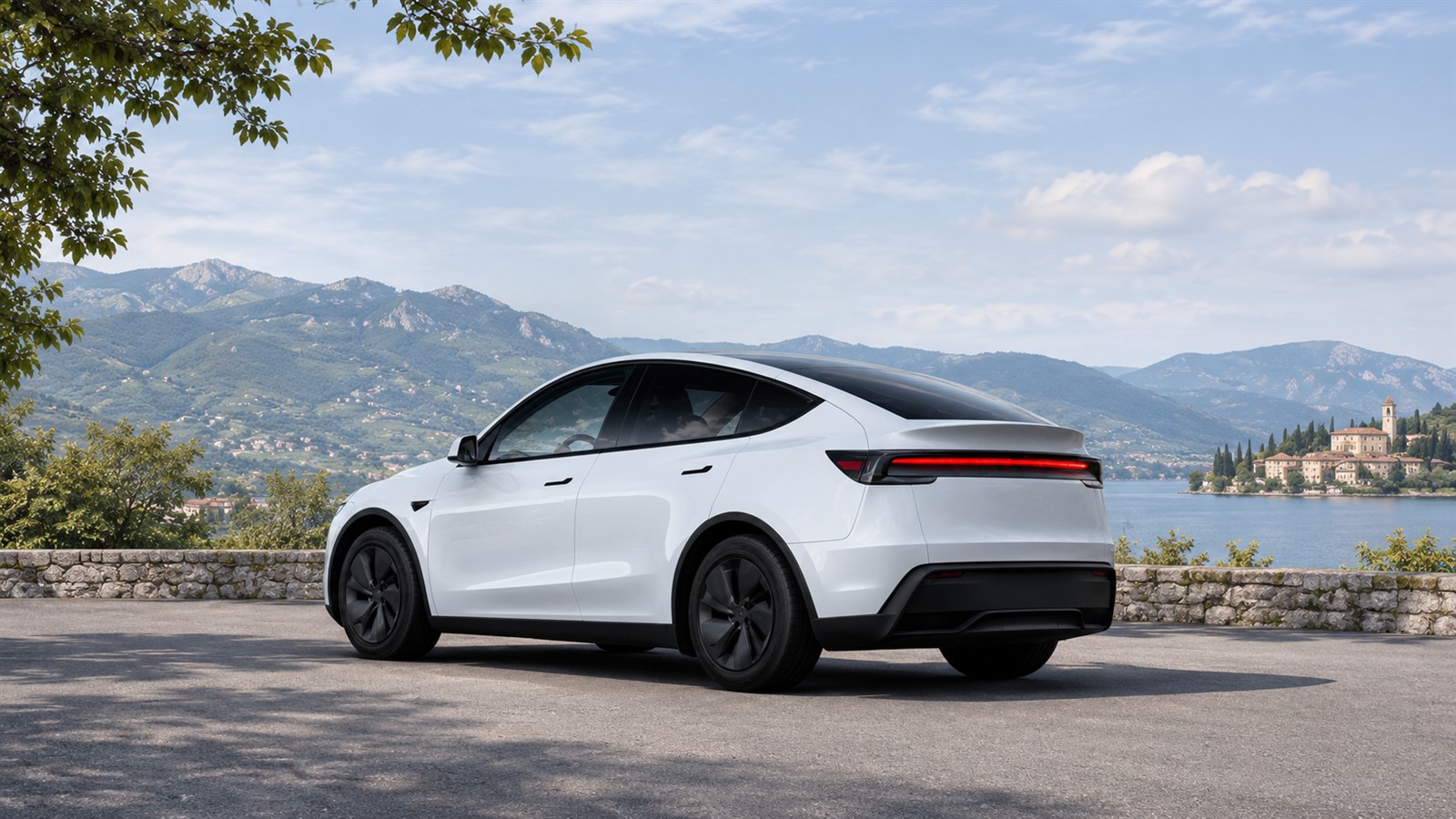
Tesla FSD in Germany still depends on the specific approval and the actual availability of the feature. On 3 November 2026, the Dutch vehicle authority RDW confirmed changes to Tesla’s supervised assistance system, including the name Tesla Assisted Driving, or TAD. The authority did not announce a completed approval covering the entire European Union. Its statement explicitly says that the EU-wide process is continuing.
For a potential Model 3 or Model Y buyer, that distinction matters more than an impressive individual demonstration. Technical capability, regulatory acceptance and activation in a particular customer vehicle are separate requirements. Headlines about Robotaxi, Cybercab and Roadster add further complexity because they concern different products and operating arrangements. This guide separates those subjects and explains what the published primary sources actually establish as of 4 November 2026.
What the latest RDW decision actually says
The RDW statement dated 3 November reports that changes to the system previously described as Full Self-Driving Supervised have been assessed and approved. Tesla Assisted Driving will appear as its name in the vehicle display, owner’s manual and driver information. The statement applies to appropriately equipped Tesla vehicles with Hardware 4.0 or later. It should not be turned into a blanket promise for older hardware.
The authority also says that the name change does not alter the system’s function. It remains driver assistance, and responsibility for driving remains with the human driver. According to the RDW, the existing approval remains valid under the same conditions and for the same use. Those qualifications are central to understanding the announcement. A different product label does not transfer the complete driving task from the person to the car.
One of the listed changes concerns the selectable speed margin, which is now limited to a maximum of ten percent rather than the fifty percent previously mentioned by the authority. The setting returns to zero at startup. This describes a system setting; it is not permission to exceed a posted speed limit. Local traffic rules and the driver’s responsibility continue to apply regardless of which settings a vehicle interface offers.
Why this does not establish general availability in Germany
The RDW identifies Belgium, Croatia, Czechia, Denmark, Estonia, Latvia, Lithuania, Slovakia and Slovenia as countries that have accepted the approval. Germany is not included in that published list. The original Dutch approval and acceptance by additional countries therefore need to be distinguished from availability throughout Europe. The list alone cannot resolve every possible German regulatory question, but it does not demonstrate a general German launch.
For the EU-wide procedure, the authority says work is continuing within the relevant technical committee, TCMV. It does not provide details of confidential discussions. There is consequently no sound basis for calculating a firm German activation date from this announcement. A release available in another market is also insufficient evidence that the same feature is permitted and enabled in a German customer vehicle.
The earlier RDW explanation from 10 April 2026 already described provisional validity in the Netherlands and possible subsequent steps elsewhere. That was a meaningful regulatory milestone. It did not eliminate the need to check the geographical scope of use. Reading the April and November explanations together provides a more reliable picture than treating either headline as an unrestricted European release.
Assisted driving still requires continuous supervision
The new name helps frame the product around assistance. A system can perform steering, acceleration and braking functions while leaving the overall driving task, including supervision, with the human. Drivers must continue to monitor traffic, understand the operating state and be ready to intervene. A long section of road completed without an obvious intervention does not, by itself, change that allocation of responsibility.
Less frequent situations are particularly important when assessing any assistance system. Temporary road layouts, emergency vehicles, obscured signs and ambiguous priority arrangements can be underrepresented in a short demonstration. Without systematic evidence, their existence proves neither a particular Tesla failure nor reliable mastery of every case. It does explain why understanding the current manual and the limitations of the enabled feature is essential.
A useful evaluation therefore asks more than whether the car completes a familiar junction. It also asks whether the interface clearly communicates its state, how attention requests are presented and how easily the driver can take control. Convenience depends on a shared understanding of the division of work. Expectations that exceed the system’s actual role can undermine the very benefit that the assistance is intended to provide.
What Model 3 and Model Y owners should check
Start with the hardware fitted to the individual vehicle. The latest RDW statement refers to Hardware 4.0 or later; a model name or registration year is not a sufficient equipment confirmation. Next check the software version, purchased package and functionality currently enabled in the relevant country. These items should be verified through the car and current manufacturer information rather than inferred from a general description of the model range.
The German Tesla Assisted Driving page is an appropriate place to check manufacturer communications. An invitation to register for information about regional test drives should not be confused with unrestricted availability. Before paying for a package, establish which functions are delivered now and which are described as potential future additions. Written clarification is more useful than assumptions based on experiences in another country.
The economic case is strongest when based on present utility. Consider your commute, the types of roads you regularly use and your willingness to supervise the system continuously. A speculative future ability to earn money as a Robotaxi is a separate proposition. Buyers relying mainly on future capabilities also accept uncertainty over timing, market availability and possible changes to product conditions.
Cross-border use deserves the same discipline. The fact that a neighbouring country appears in an acceptance list does not mean every journey there enables every function on every car. Vehicle configuration and the manufacturer’s regional implementation still matter. Check the information presented for your particular vehicle before travelling, and do not use a national approval headline as an operating instruction.
Official Tesla demonstration and its limits
The following video comes from Tesla’s official channel and illustrates Full Self-Driving Supervised. Published in September 2024, it shows the manufacturer’s approach at that time. It is not evidence of the current German approval position or identical functionality in every European vehicle. Availability and the precise software configuration must be established separately using current information.
Robotaxi and Cybercab answer different questions
Robotaxi concerns a ride service and its operation; Cybercab concerns a purpose-built vehicle. Neither should be treated as interchangeable with supervised assistance in a privately owned Model Y. On its German Assisted Driving page, Tesla places Robotaxi and Cybercab within its development towards autonomous driving. That strategic description does not establish permission to operate a commercial service in Germany. A ride service requires confirmation of its actual operating area and conditions, while a private owner needs to establish the assistance enabled in the individual car.
A German exhibition also answers a different question from road operation. Tesla advertises a Cybercab presentation in Hamburg on 27 and 28 November 2026. Visitors can inspect the design and learn about the product. A displayed vehicle, an authorised commercial service and a feature activated in private customers’ cars are three distinct facts. None should silently substitute for another in a purchasing decision.
Where the Roadster fits into the picture
The Tesla Roadster belongs to a separate product programme. Public presentations, equipment announcements and performance targets do not answer whether a supervised assistance feature is available in Germany. Roadster news should therefore not be treated as indirect confirmation of a German FSD release. Its own commercial terms and confirmed product details need to be assessed independently.
The most useful milestones from here are clear and verifiable: a published regulatory decision, an explicit geographical scope and concrete activation information for eligible vehicles. When those layers align, the practical benefit for German customers can be described with confidence. Until then, the latest RDW announcement is a documented step forward with defined limits, rather than a complete answer to every European availability question.
FAQ about Tesla FSD in Germany
Select a question to open the answer.
Is Tesla FSD now generally available in Germany?
The RDW statement assessed here does not establish general German availability. Germany is absent from its list of accepting countries, and the EU-wide process is continuing. Current regional manufacturer information and activation in the individual vehicle remain essential.
What does Tesla Assisted Driving mean?
It is the new name confirmed by the RDW for the supervised system. The authority says that renaming does not change its function as driver assistance. The human remains responsible for driving and must continue to supervise.
Which hardware does the latest announcement mention?
It refers to appropriately equipped Tesla vehicles with Hardware 4.0 or later. That is not a promise for every Model 3 or Model Y. Hardware, software, package and regional functionality must be checked together.
Does a Cybercab exhibition prove German operating approval?
No. A static product presentation does not establish authorisation for a commercial ride service or availability of assistance functions in private vehicles. A US deployment also cannot automatically be transferred to the German regulatory and operating context.
Sources and editorial date
Updated 4 November 2026. This article uses the linked RDW announcements and official Tesla pages. Approval scope, regional availability and software features may change. Announced developments are distinguished from features that are already generally available.