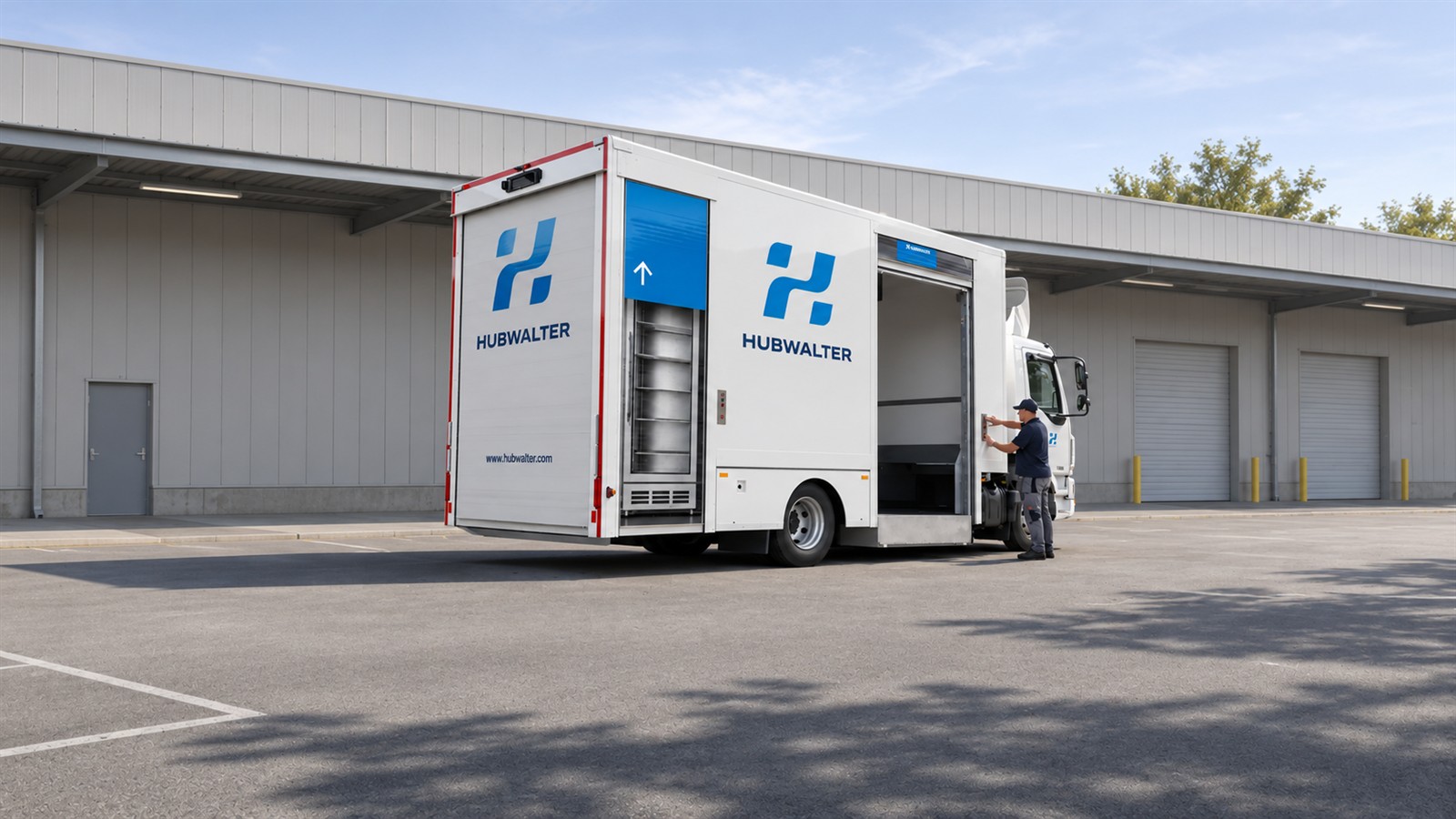
Hubwalter addresses an often underestimated part of distribution logistics: the process at the individual delivery stop. Internal lifts, access on several vehicle sides and structured loading zones are intended to make goods easier to reach. The economic benefit therefore depends less on an impressive lifting movement than on the question of how much search, travel and switching time is actually eliminated on the entire delivery route.
This guide explains the system approach based on official manufacturer information and shows how a company can check the possible benefits themselves. It does not contain its own vehicle or ergonomics test. Manufacturer information, development status and the following calculation examples are considered separately so that a possible effect does not become a blanket savings promise.
What the Hubwalter system changes
On its system page, Hubwalter describes an integrated structure for distribution traffic. The core is the interaction between access to goods, internal lift systems and loading zones. The loading units should be accessible via suitable access and be able to overcome different working or unloading heights.
This differs from the isolated selection of a single loading aid. A lift can only save time if the right goods can be reached and the further route suits the customer. A quick lifting process is of little help if several other containers have to be moved beforehand. The system must therefore be considered from loading in the depot to the return with empties.
The order of access is also crucial for multi-stop delivery routes. The next shipment should be accessible without disturbing the remaining load that has already been sensibly arranged. Different side entrances can create additional options for this. However, whether these can be used depends on the parking position, local space and the actual delivery situation.
Which variants does the manufacturer describe
The product overview differentiates between Urban Single Access, Urban Multi Access and Urban Flex. The manufacturer assigns them to different delivery route profiles and access requirements. Among other things, combinations of rear lift, side lifts and variable access configuration are mentioned. It follows that not every version has the same number and arrangement of accesses.
An interested party should therefore not only ask for the product name. The exact lift arrangement, usable loading zones and compatibility with your own loading units are important. A certain structure can make sense for standardized branch deliveries, while a delivery route with many returns needs a different distribution. The appropriate variant follows the flow of goods.
A drawing of the specific version with the intended containers is recommended for the offer. This means that occupied parking spaces, access routes and installations can be checked together. General external dimensions do not yet answer how well the roll containers or containers actually used fit into the process.
Where time is lost at the delivery stop
A reliable measurement breaks down the stop into understandable steps: find a suitable position, open access, look for goods, move the loading unit, overcome the height difference, bring it to the receiver and then secure or close it. Returns and empties should be recorded as separate processes. Only then will it become clear where a different structural system could help.
The pure lift time is only part of it. In many applications, unnecessary travel or repeated repositioning of containers can be crucial. Modified access can shorten these steps, but only if it is usable at the actual stopping point. The evaluation should therefore also include unfavorable, regularly occurring stops.
It is particularly important to compare the same initial conditions. An optimally prepared demonstration vehicle should not be compared with an existing vehicle that is disorderly loaded. Goods, sequence, drivers and delivery requirements should be as similar as possible. Otherwise, better preparation is easily attributed to the vehicle.
How seconds per stop become an annual value
The following model calculation only uses assumed values: 30 relevant stops per delivery route, 90 seconds of actually usable time savings per stop and 220 corresponding days of use per year. This results in 45 minutes per day or 165 hours per year. With an internal time value of 40 euros per hour, the calculated gross benefit is 6,600 euros annually.
Assuming an additional 15,000 euros of additional investment and 600 euros of additional annual costs, this simplified model leaves 6,000 euros of annual benefit. The simple payback would be 2.5 years. Financing, residual value and discounting are not taken into account. These numbers are not a Hubwalter offer and are not an operating effect measured by us.
| Relevant stops per day | Time released per year* | Gross benefit | Easy payback** |
|---|---|---|---|
| 15 | 82.5 h | €3,300 | approx. 5.6 years |
| 30 | 165 h | €6,600 | 2.5 years |
| 45 | 247.5 h | €9,900 | approx. 1.6 years |
*90 seconds per relevant stop, 220 days per year. **€15,000 assumed additional investment divided by the gross benefit less €600 additional annual costs; Current value 40 €/h.
The key is the word usable. A reduced downtime does not automatically generate the same amount of money in payment savings. If a fixed customer time slot prevents the customer from continuing their journey, part of the benefit may remain unused. Conversely, more punctual processes or less overtime can be economically valuable. These effects should be recorded separately and with realistic assumptions.
Manufacturer values are not a universal guarantee
The Hubwalter homepage lists possible time and cost advantages as well as a payback presentation. What is crucial for a company is the initial situation, number of stops and cost assumptions behind it. A published possible advantage should therefore serve as a reason for its own examination, not as a fixed result for every fleet.
In particular, compare the current process with a sensibly optimized reference process. Some improvements could come from changing the loading sequence. Others actually depend on the vehicle technology. A clean test makes these causes visible and helps to realistically quantify the additional benefit of the structure.
Capture ergonomics in concrete terms
Less height differences and conveniently accessible loading units can change the workflow. However, for a reliable assessment, specific activities should be documented: lifting processes, pushing and pulling, gripping heights, paths and necessary body rotations. Statements about lower stress become more understandable if it is clear which work step is actually eliminated.
The driving staff should be involved early on. Operation that appears simple in demonstration operations must remain practical even in rain, time pressure and changing delivery locations. Collect feedback in a structured manner and distinguish training problems from permanent restrictions. A single positive feedback does not replace consideration over several normal working days.
Do not hide payload, loading area and load securing
Additional technology requires weight and installation space. For the specific offer, it should therefore be checked what payload and what usable parking spaces remain after all components have been installed. Faster access is not automatically economical if the same quantity of goods then requires an additional route. The consideration must reflect the complete delivery task.
Securing loads is also part of the design. Accessibility during delivery and safe arrangement during the journey must go together. The company needs a documented solution for its containers, including returns and partially emptied loading zones. The Manufacturer FAQ can help you get started with clarifying use and introduction; The documents relating to the specific implementation remain decisive.
What the pilot companies say about the level of maturity
In the Contribution to pilot companies 2026 Hubwalter describes the planned testing with selected fleets under real conditions. Among other things, loading and uncharging times, routes, redeployment and practical suitability will be examined. The text is a description of the evaluation approach and not a published, generally valid proof of success.
For a pilot operation, goals and measurement limits should be agreed upon in advance. Which delivery routes are being considered, how long does the exam last and what support is available? Failures and maintenance are equally important. A particularly quick, successful stop must not remain the only key figure if service or availability questions later determine everyday life.
This is how you can prepare for a test week
Choose several typical routes and record quantities of goods, containers and delivery requirements. Document the initial process for a few days before the new technology is used. A comparison is then made under conditions that are as similar as possible. Deviations such as construction sites, longer customer discussions or changed delivery windows should be noted separately.
The result should be a short operational calculation and a list of practical observations: usable time savings, loading capacity, operating effort, access limits and service requirements. From this you can determine which delivery routes the system makes sense for and where a different setup would be better. Such an assignment is more helpful for procurement than a blanket judgment about all delivery vehicles.
FAQ about the Hubwalter loading system
Select a question to open the answer.
Is Hubwalter just an additional tail lift?
The manufacturer describes an integrated approach consisting of structure, internal lifts, access and loading zones. Which components are included depends on the version.
Is the system worth it on every delivery route?
This is not proven. Number of stops, containers, local access and actual time use determine the possible advantage.
Do the pilot announcements already prove solid savings?
No. They describe the testing and the intended measurement variables. For your own investment, results under suitable operating conditions are required.
Which key figure is most important for the decision?
The total effort for a completely completed, comparable delivery route. This includes time, transport capacity, operation, maintenance and availability.
Sources and editorial update
As of November 7, 2026. The basis is the official Hubwalter pages linked above. The cost and time examples are our own hypothetical model calculations. A separate vehicle, time or ergonomics test was not carried out.