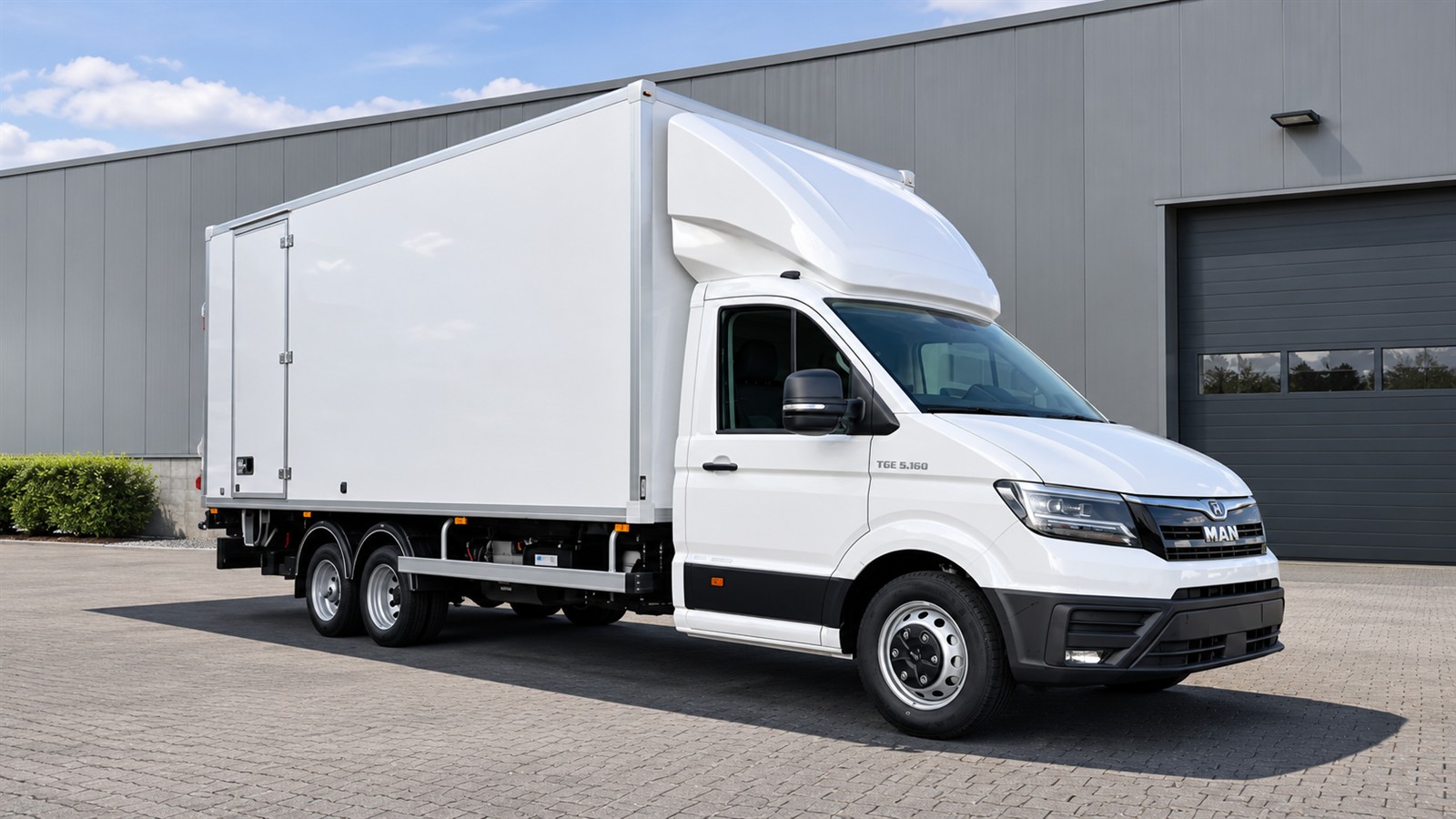
BE-Combi 3500PLUS promises more payload on a van basis: The manufacturer describes a short-coupled combination with a total weight of up to 7,000 kilograms, which is designed for the BE driving license. This can be an interesting alternative for companies in distribution transport. What is crucial, however, is which combination is actually permitted, how much payload remains after assembly and which rules apply to the specific use.
This overview explains the system using current manufacturer information and official legal sources. It does not contain its own road test. The most important distinction is: driving licenses, technical approvals, tolls and drivers’ hours regulations are separate questions. A suitable driving license class therefore does not yet answer all the organizational and economic requirements of a fleet.
What the BE-Combi-3500PLUS system does technically
According to the official product description, the system combines a light commercial vehicle, a subframe with a fifth wheel plate and a special single-axle trailer. The provider states a net payload of around 2,500 to 3,000 kilograms and setup options for a loading length of up to 5.5 meters. These ranges are configuration-dependent manufacturer information, not a guaranteed payload for every finished vehicle.
The special feature lies in the interaction between the base vehicle and the additional carrying unit. To the user, the combination can appear like a compact box-bodied van. However, the individual components and their limitations must be clearly documented for ordering, approval and operation. The external similarity to an ordinary van is not a substitute for these documents.
The system should not be equated with any BE semitrailer solution. BE-Combi offers different product areas. Statements about the payload, dimensions or operation of one version cannot automatically be transferred to another. An offer should explicitly state whether it is about 3500PLUS, another tractor conversion or a fully assembled vehicle.
7 tons with BE: What the driving license actually covers
Paragraph 6 of the Driving License Ordinance describes BE as a combination of a Class B towing vehicle and a trailer or semi-trailer with a maximum permissible total mass of 3,500 kilograms. This does not generally allow driving a seven-ton solo vehicle. An ordinary heavy truck does not become a BE vehicle through a similar structure.
BE-Combi expressly promotes the designated system for BE. Before placing an order, the driving license classification of the specific German registration should be confirmed. The actual vehicle data entered and the existing driving license including possible restrictions are decisive. For articulated combinations, weight terms and fifth-wheel loads should not be calculated independently from a sales presentation to a driving license release.
A written assignment makes sense for the company: Which vehicles belong to the combination, which documents are included and which drivers are allowed to drive exactly this version? Older driving licenses may contain additional rights that must be checked separately. Conversely, a fleet should not assume that every employee with a normal B driving license is allowed to take over the vehicle.
Compare type approval and base vehicle before purchase
The manufacturer publishes one Overview of European type approvals. This is a good starting point for interested parties to request the documents for the vehicle variant on offer. However, a general statement about the system does not replace the comparison of manufacturer, type, structure and specific design.
The base vehicle must also fit. The published Sprinter specification For example, lists required vehicle options and lists a smart tachograph. This shows why procurement should not start with just purchasing an existing van chassis. The bodybuilder needs the appropriate technical initial configuration.
Therefore, have the basic vehicle, conversion and body offered together or agreed on in writing. This makes it clear who takes responsibility for the finished combination, which approvals are involved and how warranty and service are organized. This is particularly important when dealers, vehicle manufacturers and body companies are different contacts.
The real payload counts more than the total weight
A higher permissible mass does not automatically mean more freight. Box bodies, tail lifts, cooling technology, fuel, drivers and permanently carried equipment take up weight. The reliable starting point is therefore a complete list of the operational combination and then a documented weighing of the vehicle actually delivered.
A deliberately simplified example: If the permissible total mass of the combination under consideration is 7,000 kilograms and it weighs 4,300 kilograms when ready for operation including the people and equipment already taken into account, mathematically 2,700 kilograms remain for additional cargo. This is not a measurement of a specific BE-Combi. Axle, coupling and other technical limits can further limit the usable payload.
| Example parameter | Assumed value | Meaning |
|---|---|---|
| Total limit of the combination under consideration | 7,000 kg | Technical basis of the example |
| Ready-to-use, weighed combination | 4,300 kg | Equipment and people already taken into account included |
| Calculated remaining payload | 2,700 kg | Only usable if further limits are adhered to |
Also check for unfavorable loading. A vehicle can maintain its total mass and still overload one axle. When it comes to route planning, what counts is not just how many pallets fit in, but also where the heavy items are located. Changing delivery sequences should be taken into account in the planned load distribution.
Consider cargo volume and cargo density together
A large box body can be useful for light, bulky goods without regularly reaching the maximum payload. In the case of dense building materials, however, the weight limit may be the first deciding factor. A purely hypothetical structure with 25 cubic meters of usable space and 2,500 kilograms of available payload allows an average of 100 kilograms of cargo per cubic meter. This is a ratio calculation, not a specific vehicle configuration.
This key figure helps to classify your own range. Furniture, packaged food, workshop equipment and heavy spare parts have different requirements. In addition, temperature zones, lashing options and the accessibility of individual shipments can be important. The economically suitable vehicle follows the product profile and not just the largest advertised loading area.
Toll: Observe the 3.5 tonne limit of the motor vehicle
Toll Collect explains that vehicle combinations are subject to the German truck toll only if the motor vehicle has a technically permissible total mass of more than 3.5 tonnes. It is not just the mass of the entire combination that is important. An exactly fitting vehicle configuration can make a significant difference to the toll issue.
It is important to note the distinction between technically permissible mass and a mere approval weight. Toll Collect refers to field F.1 and warns against inappropriate downrating. An advertising statement about tolls should therefore be checked against the completed vehicle documents. In addition, German toll conditions do not automatically apply in every other country of use.
BE does not automatically mean exemption from driving and rest times
The driving license must be distinguished from the social regulations in road traffic. The Regulation (EC) No. 561/2006 basically covers the transport of goods with vehicles including trailers or semi-trailers with a maximum permissible mass of over 3.5 tonnes; there are defined exceptions. Holding a BE licence therefore does not result in a general exemption for commercial transport.
For operational planning, it should be clarified which recording obligations and exceptions are relevant in the specific company. Driver card, device operation, data evaluation and tour organization may be part of the introduction effort. These positions should also be included in the comparison, as should the more easily accessible driving license class. Toll exemption and exemption from drivers’ hours regulations are different situations.
When can the concept be profitable in the fleet?
A possible advantage arises if a previously necessary second tour is no longer necessary. Assuming that a delivery weighs 2,400 kilograms, the previous transporter is only allowed to carry 1,200 kilograms and the new, specifically released combination can accommodate the entire shipment. Then two transports could become one – as long as the loading volume, load distribution and access to customers’ premises are appropriate.
Assuming an additional round trip of 40 kilometers and 200 comparable orders, 8,000 kilometers per year could be avoided. This is a planning scenario, not a manufacturer forecast. The benefits are offset by additional purchase costs, financing, maintenance, tires, insurance and possible additional organizational costs. If the second trip is combined with other deliveries in practice anyway, the advantage will be smaller.
A sensible test drive should therefore take place with typical loading, real access routes and the actual loading aids. Check turning maneuvers, visibility, ramp access and tail lift operation. Only these tasks show whether the concept fits the recurring tours. A general consumption or cost advantage cannot be derived from the system principle alone.
Official system presentation from BE-Combi
The following video comes from the official manufacturer channel BE-Combi Systems and is embedded on the company website. It explains the system; The specific weights and operating conditions must be checked based on the individual offer.
FAQ about BE-Combi 3500PLUS
Select a question to open the answer.
Can everyone with class B drive a BE-Combi?
The system is offered for BE. A normal B driving license is therefore not generally sufficient. The decisive factors are the driving license and classification of the specific permitted combination.
Is seven tons total weight seven tons of payload?
No. The vehicle, body and equipment take up a significant portion of the total mass. The actual payload must be determined for the finished vehicle.
Is the combination automatically toll-free everywhere?
No. In Germany, the technically permissible total mass of the motor vehicle is particularly relevant. For other countries and different versions, the respective conditions must be checked.
Are there no driving and rest periods due to BE?
No, this does not result in such a general exemption. Driving licenses, tolls and drivers’ hours rules must be assessed separately.
Sources and editorial update
As of November 7, 2026. The basis is the linked manufacturer documents, the driving license regulations, Toll Collect and EUR-Lex. Payload and tour calculations are explicitly hypothetical examples. A separate driving or consumption test was not carried out.