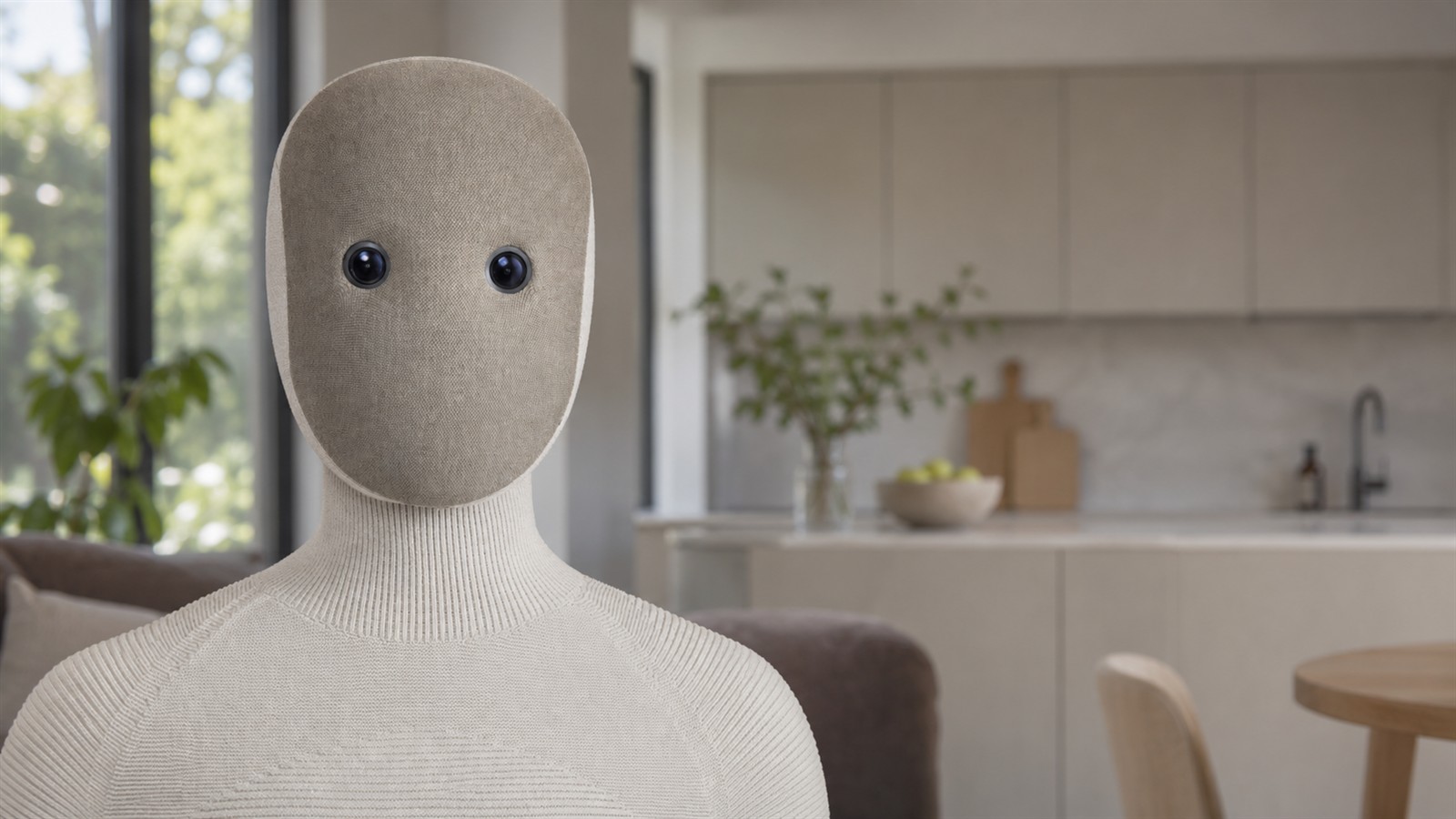
Just over a year after preorders opened, 1X NEO has become a more concrete product. That does not yet establish a dependable autonomous household helper for every home. New hands, video-based learning research and an in-house manufacturing operation represent development on several fronts. For a prospective owner, however, the decisive measure is simpler: how much work does the robot repeatedly complete without someone preparing the scene, intervening or finishing the task?
This assessment examines official 1X publications as of 7 November 2026. It is not a hands-on review. We distinguish engineering progress, the commercial offer and the evidence needed to demonstrate useful household operation. That separation makes the story more informative: a capable hand, a learning controller and an orderable product each address a different part of the problem. None alone establishes the complete experience that a household expects.
NEO one year later: What progress is documented?
The main published steps concern three layers. In January, 1X explained its World Model; in April, its factory development; and in July, a new hand design. These dated publications are available for inspection. They should not be treated as interchangeable with independent long-term evidence from ordinary customers’ homes. The assessment below therefore asks what each step establishes and what further evaluation would make its practical value clearer.
| Layer | Published development | Additional household evidence needed |
|---|---|---|
| Control | World Model research with real-world experiments | Repeatable complete tasks across changing homes |
| Hardware | New tendon-driven hands | Dexterity combined with perception and task planning |
| Manufacturing | In-house production and capacity planning | Actual customer deliveries and dependable service |
| Product | Public reservation offer | Confirmed terms for the customer’s delivery region |
What the 10,000 NEO figure actually describes
In its 30 April 2026 factory report, 1X says that annual capacity for 10,000 robots was booked within five days. The report discusses Hayward manufacturing and the prioritisation of internal testing at that time. Reserved capacity is therefore different from 10,000 robots delivered to customers’ homes. This is a manufacturer account of demand and production development.
A useful assessment follows a simple sequence: reservation, manufacture, delivery, commissioning and regular use. Each stage needs its own evidence. A completed robot may still be undergoing testing; a delivered unit may initially require setup. Recurring use is what establishes whether the overall combination of machine, software and support actually makes daily life easier.
Manufacturing capacity also does not answer the service question. Published repair turnaround, spare-parts arrangements, software support and handling of failures would be valuable information. These issues matter for a product expected to perform physical tasks repeatedly. An impressive introduction says little about the quality of support after months of ordinary use, when the novelty has passed and reliability becomes the main expectation.
World Model: A plausible plan must work in the physical home
The 1X World Model research article explains how predicted video sequences are translated into robot actions. It includes real experiments and acknowledges limitations: a convincing visual prediction can contain spatial or physical errors. That makes it a relevant research development with explicitly identified open problems.
For household use, an important question is whether a learned action remains stable under small changes. A towel may be folded differently, a cup may sit farther back or a piece of furniture may have moved. Ideally, the task should not require a new setup every time. Performance across variations of the same routine is therefore a more useful measure than the best outcome under one fixed arrangement.
Recovery matters as much as the first attempt. If something is dropped, the robot needs to recognise the changed state, assess it and continue appropriately. A published success rate should explain what counts as success: the initial grasp or the whole job including recovery? Without that definition, two similar percentages can describe very different capabilities.
A practical test would also distinguish recognition from execution. Correctly identifying the requested object is one achievement; moving it without disrupting surrounding objects is another. Recording both helps explain where a system succeeds and where it needs improvement. It avoids reducing a complex sequence to a single favourable moment.
New hands are important, but they are only one part of housework
On 9 July, 1X presented new NEO hands with 25 degrees of freedom including the wrist. The company describes tendon drive, force control and tactile feedback. These address a crucial interface with the environment: an object must be held appropriately and moved in a controlled way, rather than merely reached.
The practical problem starts before grasping and continues afterwards. A robot must select the right object, choose a suitable grip, plan its movement and place it where intended. A more capable hand expands what that sequence can achieve. By itself, it does not demonstrate understanding of an ambiguous request or dependable completion of an entire kitchen routine.
A useful comparison could examine the same tasks with several objects: a light textile, a slippery container and a small everyday item. It would record complete successes, interventions, damage and duration. That would reveal whether improved hardware creates a useful advantage for a specific application. These are proposed evaluation criteria, not results measured by this publication.
Autonomy and Expert Mode need separate scorecards
The NEO product page describes foundational autonomy for early users and scheduled Expert Mode for unfamiliar chores. A 1X expert can assist remotely. Any demonstration should therefore make clear whether NEO is operating independently or receiving help.
An assisted task can still be useful to an owner. For an assessment of autonomy, however, it is different from a routine completed without help. Another relevant question is whether assistance is needed only during initial setup or again on later repetitions. That distinction determines whether the owner receives lasting relief or must repeatedly organise additional support.
Alpha Bionic provides further context in its analysis of NEO, Expert Mode and household autonomy. It is particularly relevant to understanding the relationship between human assistance and the time-saving promise.
For a demonstration, the simplest useful record would state the operating mode beside each attempt. It should also identify any preparation that changes the difficulty, such as separating an item from a pile before the robot begins. Clear labelling lets readers appreciate technical achievement without assuming that every successful outcome was produced under the same conditions.
How much time would NEO really save?
The most informative measure is active human time saved. Consider a purely hypothetical routine that normally takes someone twelve minutes. With a robot, suppose it requires three minutes of preparation, two minutes of active monitoring and one minute of finishing work. The saving is six minutes, even if the machine takes longer overall. That can be valuable if the remaining time is genuinely available for something else.
The balance changes if continuous attention is needed throughout the task. Monitoring time should not automatically be recorded as free time. A weekly log could separate preparation, active supervision, intervention and finishing work for each routine. This produces an understandable calculation regardless of how impressive an individual movement appears.
Skipped tasks need to be counted too. Recording only successful runs gives an overly favourable picture. The relevant unit is the complete task list over several days: what was finished, what was abandoned and what a person later had to do instead? That reflects the real purchasing question, because the intended benefit is dependable relief rather than a collection of successful moments.
Owners would also benefit from comparing the robot-assisted routine with their existing method. A general-purpose machine may be attractive because it can potentially address different chores, but that flexibility should be evaluated against the effort required to organise it. The right comparison is the complete workflow that the household would actually use.
Price and Germany availability need precise terms
The official order page lists US$20,000 for Early Access, an alternative US$499 monthly subscription and a refundable US$200 deposit. It states a US delivery start in 2026. Those figures establish neither a German final price nor an individual delivery date for a German address.
Before reserving, useful answers would cover the delivery region, included services and recurring costs. Comparing ownership with a subscription requires the same time horizon and comparable service scope. Simply converting dollars into euros does not resolve those questions. The value of future capabilities can likewise be assessed only when their availability and conditions are clear.
Official NEO presentation from 1X
The video below comes from the manufacturer’s 1X channel and is linked from the official NEO product page. It introduces the product and the company’s ambitions. Manufacturer presentation material does not replace an independent everyday-use test.
Has NEO delivered on its promises?
The published developments show work on several important building blocks. They do not support a blanket conclusion that a general household helper is already proven ready for every home. Equally, open questions about daily use are not a reason to dismiss documented engineering progress. The most useful judgment follows specific routines, disclosed assistance and verifiable delivery conditions.
The next persuasive evidence would be a transparent record over several weeks: the same tasks, changing objects, all failures counted and human help clearly identified. That would show whether technical possibility has become a repeatable service. For interested households, this distinction ultimately matters more than another remarkable isolated demonstration.
FAQ about 1X NEO one year later
Select a question to open the answer.
Can NEO already perform every chore independently?
The publications assessed here do not establish that general capability. Specific tasks and the disclosed level of human assistance are what matter.
Do 10,000 reservations mean 10,000 deliveries?
No. Demand, manufacturing capacity, completed units and delivered customer robots are different measures requiring separate evidence.
What should an everyday-use test measure?
Complete task success, repeatability, interventions, active supervision and finishing work. Together, these reveal the owner’s actual reduction in effort.
Does the US offer confirm a German delivery date?
No. A prospective German customer needs explicit confirmation of delivery region, timing and applicable commercial terms.
Sources and editorial date
Updated 7 November 2026. Sources are the official 1X product, ordering, factory, World Model and hand-development pages linked above. Alpha Bionic supplies further editorial context. The numerical example and evaluation criteria are original analytical proposals; no hands-on robot test was conducted.