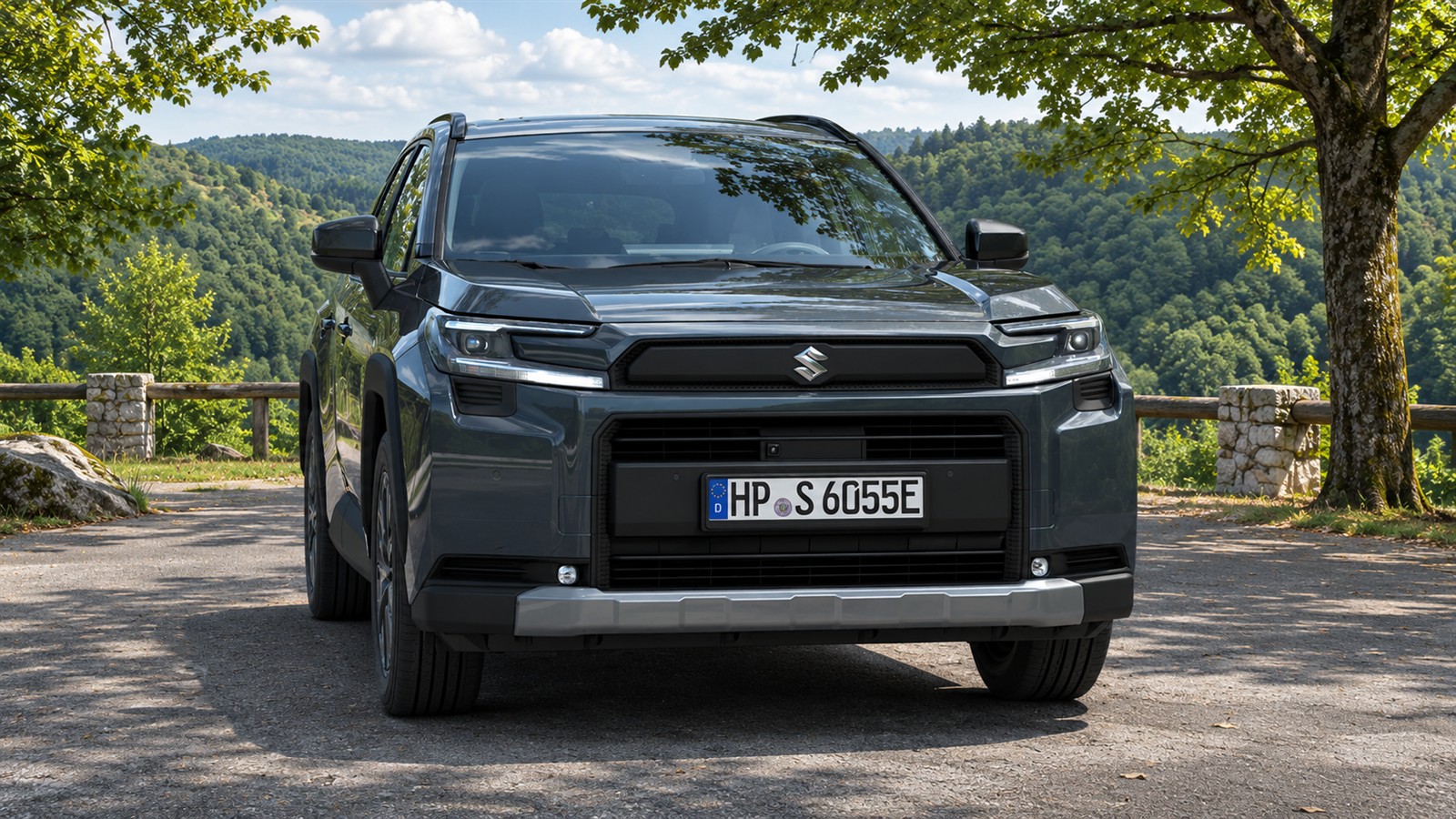
The new Suzuki Across combines a plug-in hybrid with all-wheel drive and faster external charging. For interested parties, it is particularly important to distinguish the current model version from older Across data. Anyone comparing offers should therefore explicitly assign the battery, charging capacity and equipment to the same generation.
This article uses the current official German model information and supplements a practical purchase test. It does not contain its own road test and no measured comparison with the Toyota RAV4. A common technical origin alone would not prove an identical overall price, scope of service or level of equipment.
Suzuki Across: The current German data status
The German model page states 227 kW system output, a 22.7 kWh battery and 129 kilometers of electric range according to EAER for the current Across. 11 kW AC and 50 kW DC charging power are also described. These are published manufacturer information, not our own measurement results.
As a starting point, the site lists an RRP of 55,490 euros plus delivery and registration costs. The choice of color or other components may change the specific amount. The complete configuration should therefore always be used for a price comparison.
Why older Across data must not be mixed up
A consistent model name does not mean that every Across offered has the same technical level. Ask about model generation, equipment and the data sheet of the actual vehicle. A cheaper stock offer may refer to a different version than a current product description.
This distinction particularly affects charging. If a purchase decision is based on a specific charging capacity, this must be available in the specific vehicle. Adopting current information from an older offer would not be a reliable basis.
Photos can also show different model states. Confirm the actual vehicle being offered or a unique configuration. In this way you avoid that desired functions are only recognized as not included after an order has been placed.
129 kilometers electrically: making it a requirement
The specified electrical range should be compared with your own daily profile. Write down a typical week and mark the days with reliable charging. What matters is which routes occur regularly and which only occur rarely.
A freely chosen example: A total commute of 60 kilometers and another 20 kilometers for errands results in a daily requirement of 80 kilometers. This does not mean there is a guarantee for purely electric driving. However, a clear task is created for a later test under suitable conditions.
Consider reserves and different seasons. A maximum value should not be the only planning limit available. If a vehicle needs to be recharged occasionally, this should be organizationally possible. A good purchase decision combines range with a realistic charging process.
AC and DC: Two different charging tasks
AC charging is suitable for longer downtimes, while DC charging can provide shorter recharging opportunities. However, mentioning a maximum power does not mean that it will be constant throughout the entire process. For a fair comparison, the charging window and the amount of energy required must be considered together.
With a hypothetical recharging requirement of 15 kWh, simply dividing by 11 kW would result in around 1.36 hours. This is just an idealized calculation with no losses or changes in performance. It does not describe a measured Across charging time. For practical purposes, a complete process should be documented.
Public fast charging also has additional steps. Access, free column, registration and the further route are part of the break. If this requires a major detour, a theoretically quick reload can become less attractive. Check preferred locations before regular use.
Look at electricity and gasoline consumption together
Suzuki reports a weighted combined 13.0 kWh of electricity plus 1.4 liters of gasoline per 100 kilometers. The model page says 5.4 liters per 100 kilometers for a discharged battery. These quantities must not be treated as the same operating situation.
Our recommendation is a common energy balance over a representative period of time. Record charged amounts of energy and fuel filled. Also note whether it started and ended with a similar charge level. Otherwise, an apparently low consumption can only result from an additional battery charge being used up.
For cost accounting, both types of energy require a comprehensible price. Use your actual charging rate and a realistic fuel approach. A cheap home electricity tariff should not be applied to all public recharges if they occur regularly in everyday life.
Check four-wheel drive and transport requirements
The model page describes the E-FOUR all-wheel drive and states a braked trailer load of up to 2,000 kilograms on a twelve percent gradient. The approvals and documents for the specific implementation remain decisive. A general model value does not answer every question about an individual trailer combination.
Therefore, define the transport task before placing an order. This includes real trailer mass, load and required accessories. Let us explain which limits apply to the vehicle you have chosen. If certain values are essential, they should be explicitly confirmed in the offer.
For normal journeys, it is also worth taking a sober look at the traction you actually need. A technical ability is not an end in itself. It is important that the vehicle fulfills its task reliably and remains within the budgeted budget.
Interior and luggage: Test your own task
An SUV should be viewed with its intended passengers. Adjust the front seat appropriately and then check the space in the back. A comfortable first impression can change when all seats are used at the same time and luggage is added.
Take typical items with you. The usable width and shape of the trunk can be more important for a box than an abstract liter value. Also check whether charging cables and accessories have a fixed place without blocking the space needed every day.
The same method helps with operation. Test the telephone connection, climate control and frequently used displays yourself. If you compare several vehicles, you should do the same tasks everywhere. This makes differences tangible without pretending to have your own long-term test.
Across and RAV4: This is how a price comparison becomes fair
A fair comparison should start with identical usage tasks. Request complete offers for both candidates with drive, desired equipment and additional costs. Then compare the actual features included. Similar technology does not prove that all equipment is the same.
When financing or leasing, the term, special payment and mileage must match. Add up the payments over the entire period. A single monthly amount can hide differences. Maintenance and possible additional services should also be recorded separately.
Also check the local support. Distance to the workshop, appointments and contact persons can influence everyday life. A seemingly small price advantage should be assessed together with these practical factors. This results in a personal decision instead of a blanket brand winner.
A cost accounting with reliable assumptions
Divide the calculation into fixed and variable components. The purchase price offered and certain contractual payments are fixed. Energy requirements, energy prices and subsequent residual value remain subject to change. Keeping these groups separate makes it easier to recognize the uncertainty of the outcome.
Calculate at least one favorable and one cautious scenario. If the result changes significantly, the crucial assumptions should be examined more closely before purchasing. A vehicle does not have to win in every calculation, but its benefits should remain understandable even with normal deviations.
Close open questions before ordering
End the consultation with a written list of the requirements that have not yet been checked. A specific parking space, taking a heavy object with you or the charging function at a preferred location can be crucial for everyday life. Have such points checked as practically as possible. If this is not yet possible, the offer should clearly describe its fulfillment. A signature under a general model name does not solve open technical questions. Good preparation therefore also means keeping uncertainty visible and not covering it up with an attractive list of equipment. Only then can price and personal benefit be meaningfully weighed against each other.
FAQ about the Suzuki Across
Select a question to open the answer.
Is the current Across a plug-in hybrid?
Yes. The German model page describes an externally chargeable hybrid with all-wheel drive.
What charging capacities does Suzuki mention?
For the current model version, 11 kW AC and 50 kW DC are listed on the official website. In the case of existing offers, the execution must be checked separately.
Is 1.4 liters the consumption with a discharged battery?
No. This is part of the weighted electricity and gasoline figure. A separate value is given for discharged batteries.
Is a comparison based on the model name alone useful?
No. Generation, equipment and complete costs must match the same task and the same data status.
Sources and editorial update
As of November 8, 2026. The basis is the linked official German Suzuki model page. All technical information refers to the model version described there. Calculation examples and test methods are separate classifications; A separate vehicle test did not take place.