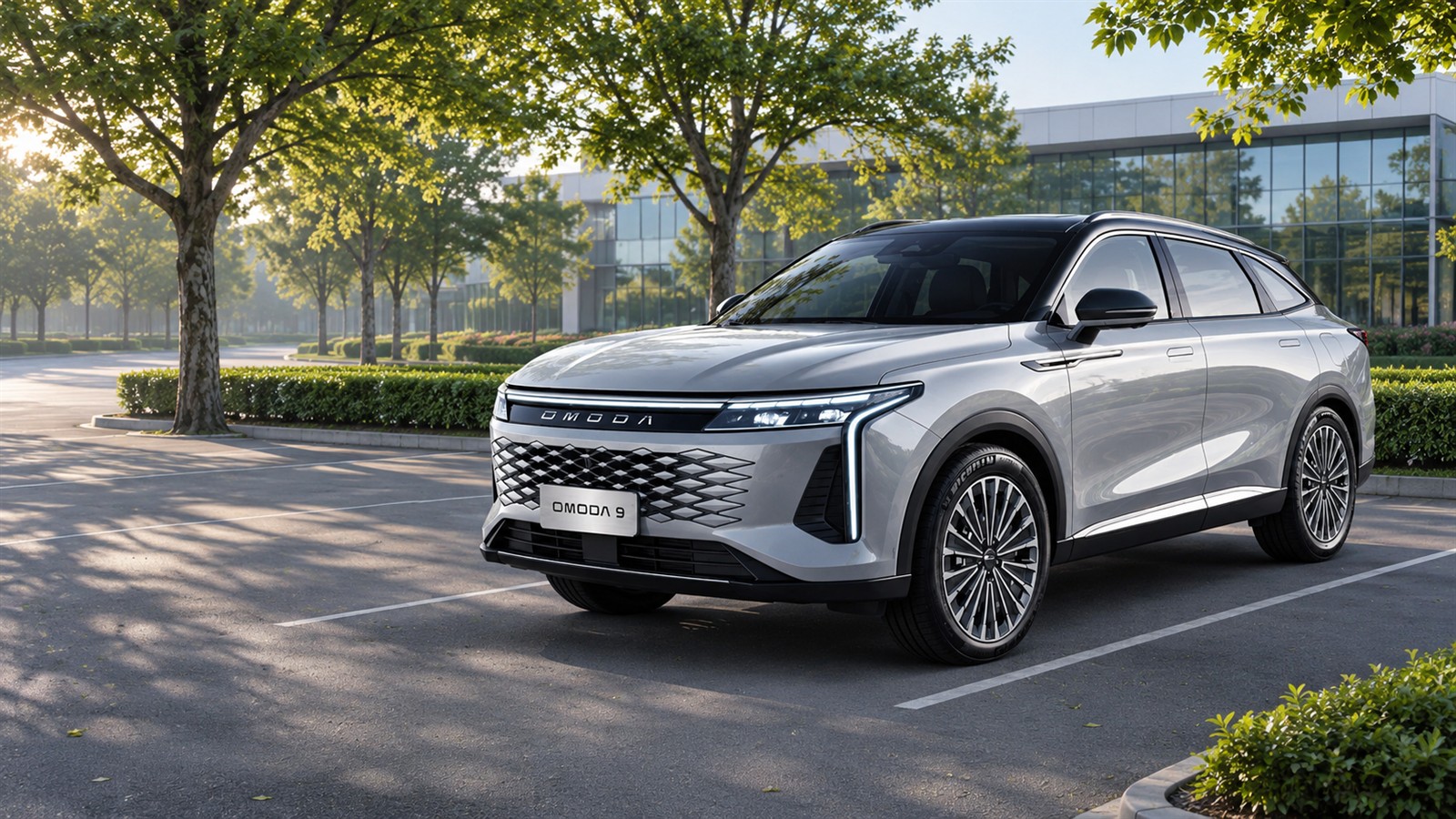
The Omoda 9 PHEV is a large plug-in hybrid with all-wheel drive and a comparatively large battery. For interested parties, the highest performance figure is therefore less important than the interaction between everyday electric life, long-distance consumption and access to charging. Anyone who recharges regularly assesses the vehicle under different conditions than someone who drives almost exclusively with a discharged traction battery.
This fact check combines official German information with a practical purchase test. It does not contain its own range or comfort test. The following recommendations help to bring manufacturer values and personal requirements onto the same basis for comparison.
Omoda 9 PHEV: price and basic concept
The German market launch notice mentions 52,900 euros as the price and describes a five-seater plug-in hybrid with 395 kW System performance. The electric range is up to 145 kilometers. These values are manufacturer information and not results measured by us.
For a specific offer, equipment, painting and additional costs should be shown individually. A communicated starting price is not automatically the final price for the desired vehicle. An interested party should also clarify which variant is actually available and which conditions apply to financing.
Read the technical data correctly
On the official technical data page there is 34.5 kWh battery capacity, a maximum of 6.6 kW AC charging power and 65 kW DC charging power. The DC window from 30 to 80 percent is 25 minutes. This is a partial recharge and not a complete battery charge.
The distinction between system performance and individual engine performance is also important. Individual peak values may not simply be added together if the manufacturer already claims system performance. When making a purchase decision, the published system information for the specific variant should serve as a reference point.
| Manufacturer information | Classification for interested parties |
|---|---|
| 34.5 kWh battery | Capacity information does not replace measured everyday consumption |
| 6.6 kW AC maximum | Vehicle also has a more powerful AC column |
| 65 kW DC maximum | Peak performance is not a permanent means of charging |
| 30-80 percent in 25 minutes | Consider named loading window and conditions |
Why 1.6 liters is not the entire consumption figure
The German data site shows a weighted combined 19.5 kWh of electricity plus 1.6 liters of gasoline per 100 kilometers. When the battery is discharged, it says 6.9 liters per 100 kilometers. This information describes various operating conditions. Using the low weighted gasoline value in isolation as long-term long-distance consumption would be misleading.
For your own comparison, electricity and fuel should be recorded together. Write down the amount of energy charged, the liters filled and the distances actually traveled. A single on-board computer value does not necessarily reflect all the amounts of energy obtained from outside. Longer-term documentation is particularly useful when charging habits change.
Consumption of a brochure is not an individual commitment. What matters is how often the car starts, how long it sits at the charging point and which route is then driven. The energy requirements of a short city trip can differ significantly from a longer, quick trip.
Bringing together electric range and daily commutes
First create a typical weekly plan. Enter commutes, shopping and additional trips. Differentiate between days with predictable routes and days with frequent changes. This creates a reliable requirement before a range information is assessed as suitable or unsuitable.
A hypothetical household could drive 45 kilometers on four days and 110 kilometers on another day. It is important to check whether and when it can be recharged. The calculation does not prove that all routes are covered electrically. It simply shows which daily profiles should be examined in a test drive.
Consider an appropriate buffer. Weather, load and speed can change the practical route available. If you base your entire planning on a maximum value without reserve, you create unnecessary time pressure. A flexible charging opportunity can be more important in everyday life than a particularly good individual value.
AC charging at home: the available time window counts
A stronger wallbox does not require a higher charging power than the vehicle supports. When planning, the charging point, vehicle and electrical installation should be considered together. A specialist company can assess which solution is suitable for your own parking space. A blanket recommendation for every house installation would not make sense.
A simple model calculation illustrates the magnitude: If 20 kWh have to be recharged in one evening, dividing by 6.6 kW theoretically results in a good three hours. In practice, there are additional losses and possibly reduced performance. The example does not describe a measured Omoda charging time.
The reliability of access is also important. A public column next to the apartment can be convenient as long as it is free and functional. Consider a second option if the electric driving portion is essential to profitability. Regular charging should fit into everyday life.
Long distance: honestly compare breaks and energy requirements
For a longer journey, we recommend looking from a full battery to your destination. The route, intermediate charging, fuel and duration of breaks should be documented. This is the only way to see what proportion the initially charged energy contributed to the overall result.
An additional charging break is not automatically economical. Compare the price of energy, the amount recharged and the detour required. If a longer break is planned anyway, a reload can be assessed differently than if the location was visited solely for this purpose. The personal time value is part of the decision.
Even a particularly high total range specification does not replace this consideration. The question is how pleasant and predictable an ordinary trip is. These include seating comfort, noise, operation and the availability of suitable stops. You should check these properties yourself during a later test drive.
Check available space and trailer requirements separately
The German introduction describes five seats, 471 liters of trunk space according to VDA and up to 1,500 kilograms of braked trailer load. The documents for the ordered version remain relevant for the specific use. A general model specification does not replace checking the vehicle documents and trailer combination.
Take typical travel luggage or the designated transport box with you when viewing. The shape of an opening can be more important than the volume. Also check the position of cable bags and other items you carry with you permanently. Anything left in the trunk reduces the actual space available.
Clarify service and costs before placing an order
Request a specific contact person for maintenance and repairs. Distance, scheduling appointments and support in the event of a longer outage are interesting. General statements about a service network do not yet answer what your personal process will look like if necessary.
A complete cost calculation includes purchase, financing, energy, maintenance, insurance and residual value. Expect at least two scenarios: regular reloading and infrequent reloading. This makes it clear how much the result depends on a habit that could change over the period of use.
A deliberately simple sensitivity calculation can help. If an assumption changes the annual costs by 400 euros, that’s already 2,000 euros over five years. This self-selected size is not a forecast for the Omoda. It shows why small ongoing differences can become relevant when comparing vehicles.
Complete a test drive with clear tasks
If possible, arrange a trip with the version that interests you. Check maneuvering slowly, parking in the usual parking space and the comprehensibility of important displays. First have the operation explained to you and then carry out the steps yourself. Write down open points immediately after the trip. If there are two prospective buyers, both should complete the same tasks. This turns a general presentation into a comprehensible comparison. If a crucial function has not yet been checked, it belongs on the list of questions to be clarified before the contract is concluded.
Original video from the manufacturer
The official German manufacturer channel shows the Omoda 9 PHEV in a short product presentation.
FAQ about the Omoda 9 PHEV
Select a question to open the answer.
Is the Omoda 9 a purely electric car?
No. The German version described here is a plug-in hybrid with a gasoline engine and externally chargeable battery.
Is 1.6 liters the consumption when the battery is empty?
No. The weighted value is part of a combined electricity and gasoline figure. The manufacturer gives its own value for a discharged battery.
Does 25 minutes refer to a complete charge?
No. The published DC time concerns the window from 30 to 80 percent.
For whom is regular charging particularly important?
For interested parties whose deployment planning and cost calculations are based on a high proportion of electric driving. This proportion must be achievable in your own everyday life.
Sources and editorial update
As of: November 8, 2026. The basis is the linked official German manufacturer information. The video comes from the OMODA & JAECOO Germany channel linked on the manufacturer’s website. All calculation examples and checklists are editorial analysis; Our own driving or loading measurements are not available.