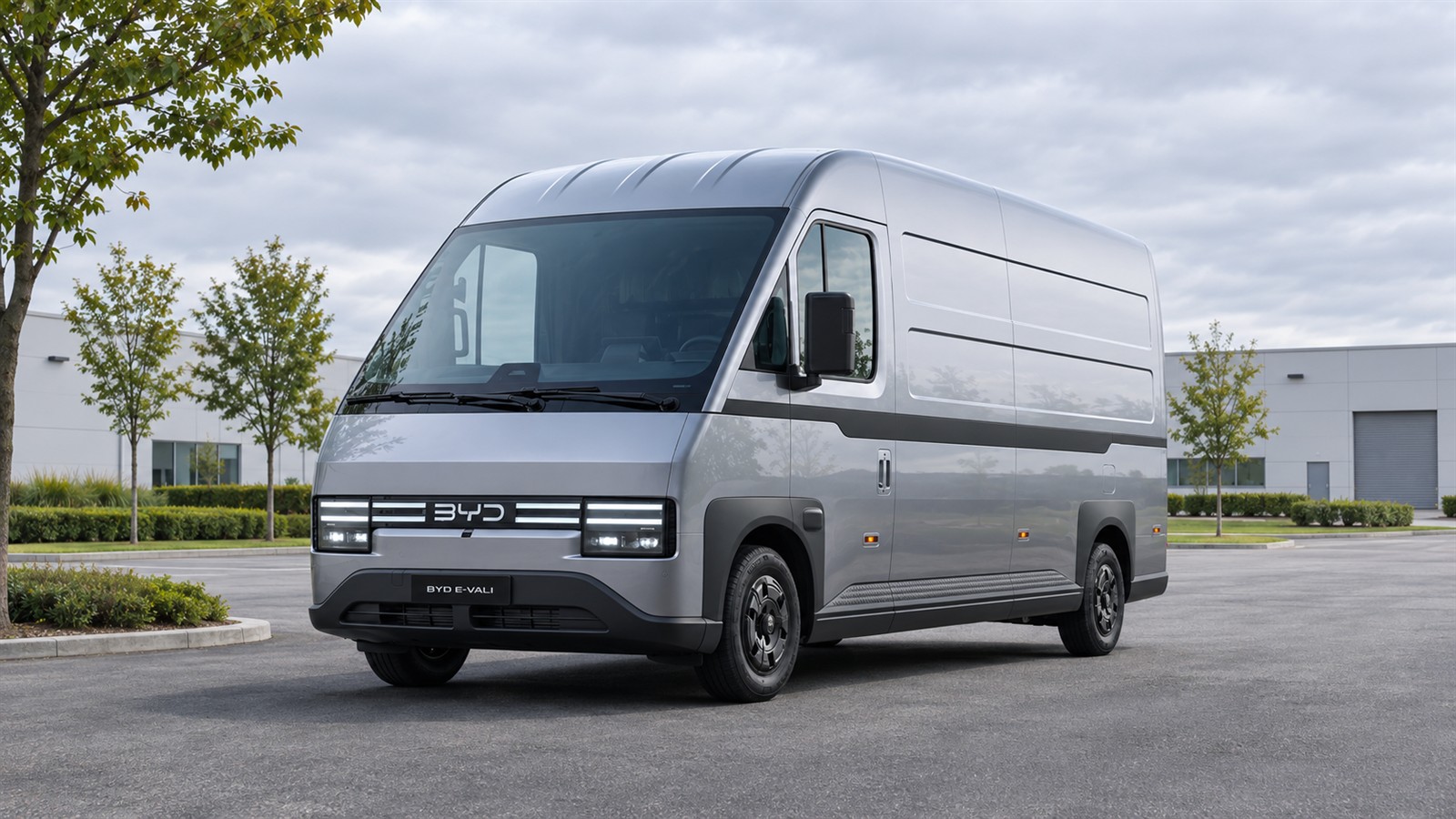
The BYD E-VALI is designed as an electric panel van for delivery services and the last mile. For German companies, however, what is crucial is which version is actually offered and which information is already binding. An exhibited machine, a foreign product page and a German fleet vehicle that can be ordered are different stages of development and sales.
This overview classifies the official BYD publications and shows which questions should be clarified before purchasing. The allocation of payload and weight class, the actual tour requirements and the loading organization are particularly important. The article does not contain its own road test and does not derive a German delivery promise from an international announcement.
BYD E-VALI: Consider presentation and market status separately
BYD officially presented the E-VALI at the IAA Transportation 2024. At that time, versions with 3.5 and 4.25 tons and ranges of 220 to 250 kilometers were described, depending on the variant. The publication mentions Blade battery technology and its use in European delivery traffic. It is a dated starting point, not a replacement for a current German offer.
The Danish BYD product page is explicit about its status: The vehicle shown is a prototype, final specifications have not yet been determined and an order is not yet possible there. The expected sizes mentioned are up to 1,450 kilograms of payload, a range of up to 250 kilometers and around 30 minutes for the fast charging window of ten to 80 percent. A price is not mentioned.
This information must be read with its market reference. They describe the Danish information status and may not be presented as a complete German price list or delivery plan. For interested parties in Germany, binding information on the specific implementation is therefore more important than a summary of as many international maximum values as possible.
Which data can already help you make a decision
| Information | Classification | To be clarified before ordering |
|---|---|---|
| 3.5 and 4.25 ton versions | Called in the European imagination | Which variant is offered in the target market? |
| 220-250 km range | Historical manufacturer information by variant | Current homologated values and test conditions |
| Up to 1,450 kg payload | Expected maximum value on the Danish side | Assignment to weight class and features |
| Price | Not published there | Binding complete offer |
The table is deliberately not a final German data sheet. It shows the different levels of evidence. For a fleet, each number should also be assigned to a specific body, battery and equipment variant. Where this assignment is missing, the information remains an orientation instead of a reliable procurement basis.
Do not mix payload figures from different weight classes
A particularly common comparison error occurs when a high payload from a heavier variant is combined with the operating conditions of a lighter vehicle. This is relevant for delivery companies because driving licenses, technical limits and the actual amount of freight must all match. A maximum value alone does not say what a fully equipped van can carry in your own company.
Therefore, record the vehicle weight, people, shelves, loading aids and permanently carried equipment. A clearly hypothetical example: If 1,000 kilograms of payload is confirmed for a specific variant and subsequent installations and equipment not yet taken into account take up 180 kilograms, the mathematical figure remaining is 820 kilograms. This is not an E-VALI specification, but a simple test method.
Weight distribution also counts. Compliance with the overall limit does not automatically guarantee compliance with every axle load. Especially when delivery sequences change, the company should check how heavy items are distributed in the vehicle. This requires the actual data of the selected version and a suitable loading plan.
3.5 and 4.25 tons: check your driving license in advance
The Driver’s License Regulation basically contains the limit of 3,500 kilograms for class B and also a conditional regulation for certain alternatively powered freight vehicles up to 4,250 kilograms. This does not result in a general approval of every heavier electric van for every B driving license.
For an offer, it should therefore be clarified whether the specific vehicle and its use fall under a corresponding regulation and which drivers can be used. The mere product name does not answer this question. A fleet only gains flexibility if the technically suitable variant can also be driven organizationally with the available personnel.
What range does a delivery fleet really need?
The right range requirement starts with your own tours. Record a representative week with start and end points, load, road types, idle times and a reserve for unplanned trips. The longest conceivable exception should not go unnoticed and become the benchmark for every vehicle. Likewise, the shortest day is not sufficient as a basis for the entire fleet.
A hypothetical daily plan could consist of 145 kilometers of regular tour, 25 kilometers of additional pickup and 30 kilometers of operational reserve. The company must then demonstrate reliable operational capability for 200 kilometers under its conditions. This calculation does not prove that a particular E-VALI does the job. It first defines the requirement for a test drive and a binding offer.
With many stops, doors, air conditioning and waiting times change the energy requirement. Motorway share and weather should also be taken into account. A sensible vehicle test therefore connects the route with the actual delivery processes. Just an empty round trip under favorable conditions does not adequately represent a normal delivery day.
Quick charging and depot charging have different tasks
A fast charging window of ten to 80 percent is not the same as a full charge. It should also not be mixed with charging times of other models or other temperature conditions. What matters when planning your tour is whether enough energy can be recharged for the next section during the planned break.
Depot charging, on the other hand, can often be organized over the entire downtime. Assume that for a purely hypothetical fleet, 45 kWh per vehicle needs to be recharged at night and there are eight hours available. Without losses, this would correspond to an average of around 5.6 kW per vehicle. For ten vehicles at the same time it would be around 56 kW. This is a planning calculation, not a technical charging recommendation for the E-VALI.
The available network power, load management and the actually supported vehicle charging power must be checked together. A large connection at a single charging point does not replace a usable distribution across the entire fleet. Conversely, intelligent time staggering can change the expansion effort if the downtime is long enough.
Why truck charging technology does not automatically apply to the E-VALI
BYD’s German commercial vehicle communication for the IAA 2026 describes, among other things, heavy trucks, large battery systems and megawatt charging technology. This information belongs to the vehicles described there. They may not be used as charging power or battery data for the E-VALI.
This separation is essential for the purchase decision. A manufacturer can offer different commercial vehicle classes with completely different interfaces, energy quantities and application profiles. A meaningful comparison remains with a specific transporter and its confirmed configuration. Brand-wide technology announcements provide context, not an individual spec sheet.
Test the operation and loading space on the real tour
Many small work steps are crucial in the delivery service. Check entry, seating position, visibility, mirrors, door operation and access to the goods. Less effort per stop can add up over the course of the day. At the same time, unfavorable doors or long search routes can offset some of the advantages of an electric drive in the overall process.
A good test list therefore includes the typical goods, common containers and the most difficult regularly accessed routes. Document necessary maneuvering, loading height and accessibility of individual shipments. The comparison should be made with the intended driving staff and a known reference tour. This creates usable observations instead of mere impressions.
Evaluate price, service and residual value together
As long as there is no binding German offer, a general price advantage over established vans cannot be clearly proven. The basis for comparison would have to take into account weight class, battery, body, equipment and scope of service. Individual foreign information or prices of other BYD models are no substitute for this.
The total costs include energy, maintenance, insurance, tires, charging infrastructure and residual value on the same calculation basis. A meaningful comparison reveals uncertain assumptions. In addition, it should be clarified which workshop will look after the specific commercial vehicle version, how spare parts will be procured and which mobility solution is provided in the event of a longer outage.
The E-VALI is therefore a relevant vehicle project for European delivery logistics. However, whether it will be the right alternative for a specific German company depends on the confirmed offer together with a realistic operational test. The most important advances would be clear regional conditions, comprehensible variant data and a resilient service organization.
FAQ about the BYD E-VALI
Select a question to open the answer.
Was the E-VALI only introduced in 2026?
The official European presentation took place in 2024. Later presentations must be distinguished from this and from the regional orderability.
Does a payload of 1,450 kilograms apply to each version?
This cannot be deduced from the Danish site evaluated. The maximum value must be assigned to a specific weight class and equipment.
Is the Danish price known?
No price is mentioned on the checked product page. No German final price can be derived from this.
Can the fast charging technology of the heavy BYD trucks be adopted?
No. Batteries and charging interfaces must be confirmed for the E-VALI itself. Technical information from other commercial vehicles is not transferable.
Sources and editorial update
As of November 7, 2026. Sources are the linked official BYD pages and the driving license regulations. Foreign market information is expressly classified as such. All calculation examples are hypothetical; A separate driving or consumption test was not carried out.