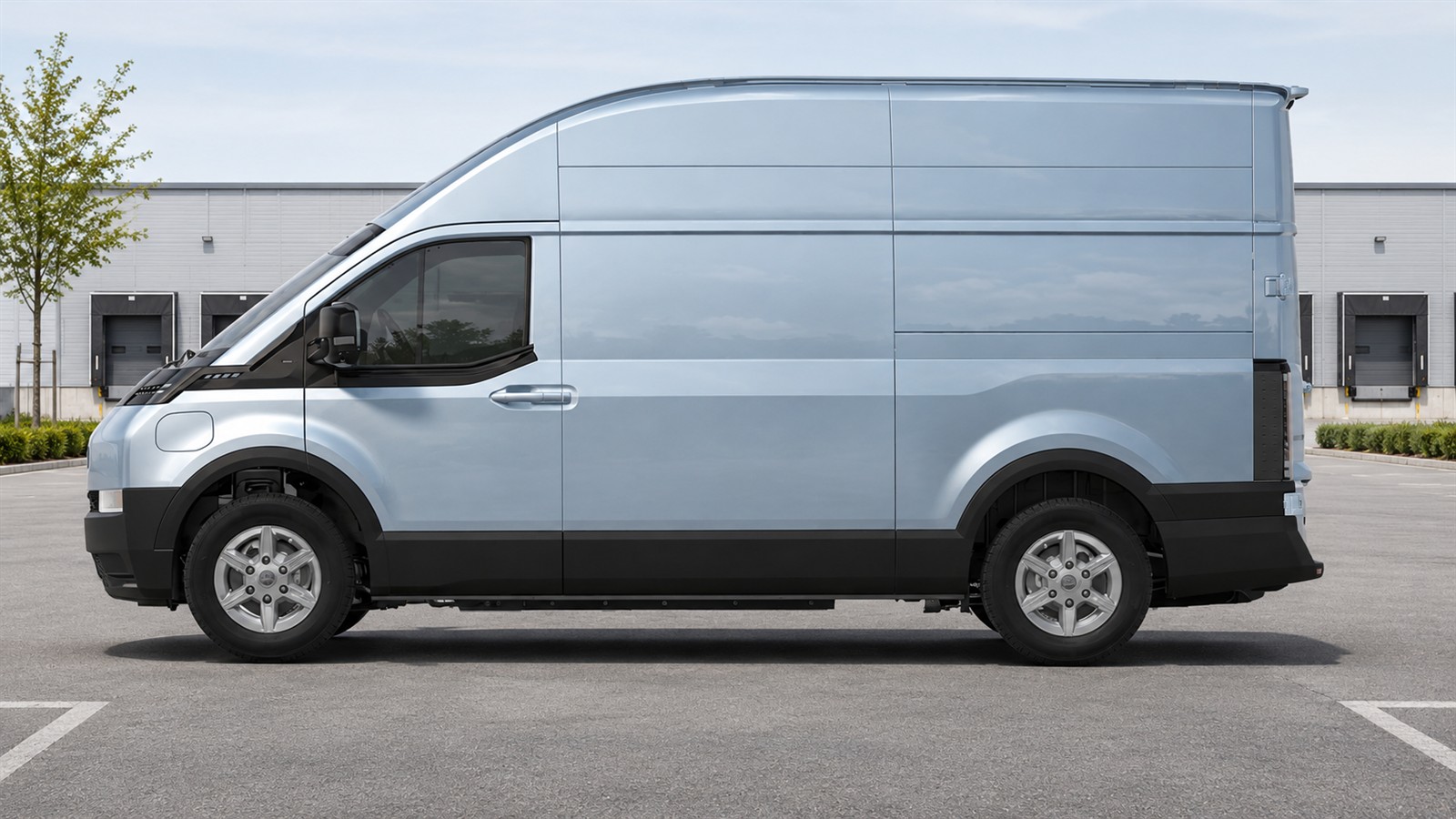
DELIVAN wants to launch electric vans in Europe and Great Britain in 2027. The commercial vehicle brand from Chery Commercial Vehicle has presented the L1H1 and L2H3 series as well as solutions for bodies. What is particularly interesting for German companies is how range, payload and service interact. However, a reliable price advantage over established vans cannot be derived from a product presentation alone.
This overview separates the announced market launch from published technical data and supplements a practical checklist for fleets. The basis is official manufacturer websites, not our own road test. The decisive benchmark is the complete daily task: The vehicle must transport goods or equipment, load within the available time and be reliably supported during operation.
DELIVAN: What has been announced for Europe
In the announcement of September 15, 2026, DELIVAN announces the commercial launch in Europe and Great Britain for 2027. Two electric basic vehicles and four specialized conversions were presented. The announcement also describes the development of European structures. This does not yet confirm an individual delivery date for a specific German order.
For an interested party, several steps have to be separated: the presentation of a series, the publication of specifications, a binding offer and the actual delivery. Only a concrete contract answers questions about equipment, delivery location and scope of services. An announced announced year should therefore be treated as a planning horizon in your own investment planning until reliable conditions are available.
L1H1 and L2H3 fulfill different tasks
The L1H1 product page mentions up to 6.9 cubic meters of cargo space. With the 50.4 kWh battery, a maximum payload of 1,400 kilograms is specified; with 68.7 kWh it is 1,320 kilograms. The combined WLTP ranges mentioned there are 256 and 343 kilometers, respectively, with the maximum speed limited to 100 km/h.
The larger model L2H3 offers up to 11.6 cubic meters of cargo space, according to the manufacturer. There are three battery sizes here. This vehicle in particular shows why the largest individual values cannot be combined into a fictitious desired configuration: The larger battery increases the published range, but reduces the specified maximum payload.
| L2H3 according to manufacturer | 50.4 kWh | 68.7 kWh | 97.4 kWh |
|---|---|---|---|
| Combined WLTP range* | 216 km | 285 km | 426 km |
| Maximum payload | 1,300 kg | 1,220 kg | 1,000 kg |
| Total mass according to data page | 3,500 kg | 3,500 kg | 3,500 kg |
*Published manufacturer values with a maximum speed limit of 100 km/h. Final regional design and individual equipment must be checked.
Why 426 kilometers and 1,300 kilograms do not describe the same variant
For procurement, the required payload should first be determined. A service technician with a permanently installed workshop has a different profile than a parcel fleet with changing shipments. Tools, shelves and special equipment add weight before the first goods are loaded. The right battery is therefore the result of a joint look at the route and operational mass.
A hypothetical example illustrates the conflict: If a company regularly requires an additional payload of 1,100 kilograms, a configuration with only 1,000 kilograms of maximum payload would be unsuitable without additional installations. A high range specification does not solve this problem. Conversely, a smaller battery with sufficient range may be a more suitable choice if it allows the necessary payload.
A binding weight list is therefore recommended for the offer. The specific vehicle, installations, loading aids and the people intended for use should be recorded. It is then necessary to check which load is actually still permitted. The final weighing of the finished vehicle is more meaningful than adopting a general brochure maximum.
Compare WLTP range with your own driving profile
The published speed limit condition deserves special attention. It is part of the information and should remain visible in a comparison with other transporters. Rapid highway deployment, additional structures or other operating conditions can result in significantly different energy requirements. A range value is therefore not a promise for every tour.
Record daily kilometers, load, highway share, idle times and temperature for a representative week. Not only the average day is interesting, but also a frequently occurring unfavorable deployment. If you only choose your vehicle based on the shortest delivery day, you may need additional charging breaks or replacement vehicles later. On the other hand, if you want to cover every rare exception, you may be purchasing an unnecessary amount of battery weight.
A sensible decision therefore combines a clearly described rule tour with a plan for exceptions. An interim charge, a different tour distribution or a single reserve vehicle can be more economical than the largest battery in every transporter. These possibilities must be tested against real processes; No general recommendation for every company can be derived from the published ranges.
22 minutes of quick charging: Read the charging window
DELIVAN states on the product pages around 22 minutes for DC charging from 15 to 80 percent. This describes a specific charging window and not a full charge from empty to full. The confirmed conditions and the actually available charging infrastructure are also relevant for deployment planning.
A calculation example shows why the distinction is important: 65 percentage points of a nominal 68.7 kWh battery correspond to around 44.7 kWh. To transmit this amount of energy in 22 minutes, the idealized average would require around 122 kW. This is a plausibility calculation with the stated capacity, not a measured charging history. Usable capacity, losses and charging curve must be taken into account for the real evaluation.
Even a suitable fast charging station does not provide a reliable break. Access, occupancy, payment and the position of the charging port are part of the process. For depot charging, however, the available connected power, vehicles charging at the same time and the time window until the next departure are crucial. This infrastructure should be planned before ordering the vehicle.
Bodies and service are part of the product
In its announcement, DELIVAN names, among others, conversion partnerships with GRUAU, SORTIMO, JUNGE and BOTT. The brand also describes DELIVAN I for connectivity, DELIVAN PRO for service and availability, and DELIVAN X for customization. Such structures can be important for commercial users; However, their specific performance must be comprehensible in the respective market and offer.
For a trade business, what counts is accessible contacts, spare parts and the treatment of a broken down vehicle. A general service name does not answer who will repair on site and how quickly a replacement part will be available. Therefore, ask for information about responsibility, repair process and mobility replacement. It should also be clarified how vehicle and body manufacturers define their responsibilities.
When it comes to digital fleet functions, the actual scope is crucial. Which data can be exported, which services cost money on an ongoing basis and how long are they available? A usable solution must fit into the existing disposition. Additional data collections without usable evaluation alone do not create an operational advantage.
Is DELIVAN cheaper than established vans?
No reliable general German price comparison can be derived from the official pages evaluated. For a fair comparison, the battery, body, equipment, warranty, service and charging equipment would have to match. A low starting price for a simple variant would not be directly comparable to a fully equipped competition vehicle.
A helpful calculation calculates over the same period and the same mileage. Purchase or leasing, energy, maintenance, tires, insurance, infrastructure and expected residual value are taken into account. Downtime should be reported separately with its own assumption. Then it becomes clear which price component is actually decisive and where uncertain assumptions change the result.
The final test is a test drive with typical load and real access roads. In addition to consumption and range, this includes visibility, entry, door operation, loading height and maneuvering at the location. A van earns its money through many repeated operations. It is precisely these repetitions that should be comprehensibly tested before a major fleet decision is made.
FAQ about DELIVAN in Germany
Select a question to open the answer.
When should DELIVAN start in Europe?
The official announcement lists 2027 as the planned commercial launch. This does not result in an individual German delivery date.
Does each L2H3 have the greatest range and payload at the same time?
No. The published variants differ. The largest battery is specified with a lower maximum payload than the smallest.
Does 22 minutes represent a full charge?
No. The manufacturer’s information applies to 15 to 80 percent. For your own planning, you need to check the connection, charging conditions and the required time window.
Is a German price advantage already proven?
A general price advantage cannot be proven from the sources evaluated. What is crucial is a comparable, binding offer for the specific implementation.
Sources and editorial update
As of: November 7, 2026. The basis is the linked official DELIVAN product pages and the manufacturer’s announcement. Technical data and regional offers may change until market launch. The calculation examples are our own model calculations; an own vehicle test was not carried out.