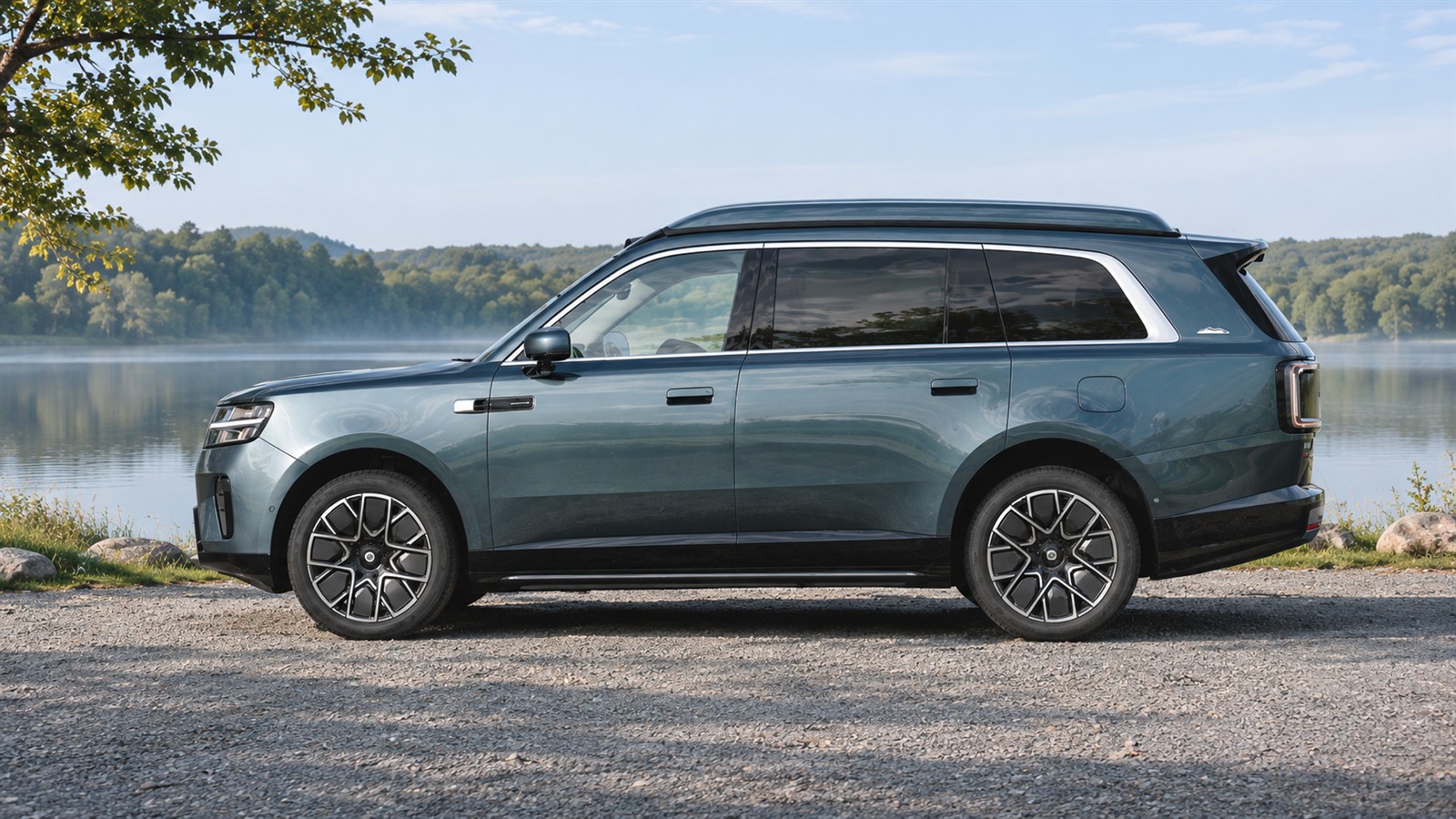
The Xiaomi SkyNomad N90 Max Studio combines a large SUV with a factory-integrated lifting roof, an electrically convertible second row and a living-space-oriented interior. It is an interesting proposition for people hoping to combine everyday travel, mobile work and occasional overnight stays in one vehicle. Its distinctive feature is the interaction between roof, floor and seating, rather than a sleeping surface alone.
The current international manufacturer name is N90 Max Studio. Keep that version separate from the seven-seat N90 Max: the Studio has a redesigned five-seat interior. Its extended-range powertrain also needs careful explanation. A large combined-range figure is not an electric-only range. This assessment uses manufacturer documentation and is not based on our own driving, range or overnight test.
Xiaomi N90 Max Studio: price and market context
Xiaomi’s official September 2026 launch announcement lists the N90 Max Studio at RMB 299,900 and the seven-seat N90 Max at RMB 269,900. These are Chinese-market prices. They are not European retail offers, and a currency conversion cannot turn them into a binding local quotation.
The announcement explicitly limits current availability to the Chinese Mainland. Anyone considering a purchase therefore needs clarity about the vehicle actually offered, servicing, language support, charging equipment and conditions in the intended destination. A brand’s international presence does not answer those model-specific questions.
| Item | Studio specification stated by Xiaomi |
|---|---|
| Concept | Five-seat SUV with factory-integrated electric lifting roof |
| Chinese launch price | RMB 299,900 |
| Battery | 76 kWh |
| Electric-only range | Up to 462 km, CLTC |
| Combined range | Up to 1,688 km, CLTC |
| Lower bed | 1.87 × 1.24 m; conversion in approximately 30 seconds |
| Upper level | 2.11 × 0.985 m activity area; bed board up to 1.946 m long |
These are published manufacturer figures, not independently measured results. The precise configuration matters when ordering. Accessories and individual features may be optional; a well-equipped presentation vehicle does not establish what every offer includes. Request an itemised specification rather than relying on the most attractive photograph.
A lifting roof integrated into the vehicle
The Studio’s electrically raised roof forms part of the vehicle concept. Xiaomi describes an upper level with ventilation outlets, a charging connection and a mattress. The stated upper-structure load capacity is up to 200 kg. That is a specific figure for the intended upper level, rather than a general approval for arbitrary loads placed anywhere on the roof.
Access, movement and closing the roof when conditions deteriorate matter as much as the floor area. Try organising clothing and footwear while using the upper level. Check whether the night layout can be prepared without moving most of the luggage outside. For short stops, that practical sequence may determine whether the feature is used regularly.
At just under a metre wide, the upper level is not a broad double bed. Do not plan occupancy solely by counting possible sleeping positions. Body size, shoulder room, mattress comfort and freedom to move are personal considerations. Lying down in the actual vehicle provides more useful information than a general description such as “loft”.
The second row becomes a bed
Xiaomi says the second row converts into a 1.87 m by 1.24 m sleeping surface in approximately 30 seconds. Its split arrangement supports different sitting and resting layouts. This offers an interesting possibility: a short break need not require converting every part of the cabin at once.
Nevertheless, the dimensions justify a personal trial. A 1.24 m width can feel quite different from a bed at home for two adults. Someone taller than 1.87 m should check the actual usable length rather than assuming a comfortable fit. Upholstery contours, transitions and front-seat positions all affect the experience. A smooth-looking promotional image cannot settle those questions.
Luggage is part of the same test. Bags, charging cables and other equipment need a place when the seats become a bed. Sketch the complete night configuration, including occupants, food and items that must remain accessible. A workable storage plan can be more valuable than another electronic comfort feature.
Run the conversion as it would happen during a trip. Start with the day’s normal seating arrangement and realistic luggage, then time the whole sequence until sleeping is possible. The mechanical movement may be quick, while reorganising belongings takes longer. That difference is relevant to anyone planning frequent overnight stops.
Extended range: two numbers describing different things
SkyNomad combines electric propulsion, a large battery and a combustion-powered range extender. Xiaomi’s Kunlun architecture introduction explains the family concept. The current Studio announcement specifies 462 km electric-only and 1,688 km combined range, both using the Chinese CLTC procedure.
The combined figure includes energy from battery and fuel. It must not be described as electric range or directly equated with a pure battery vehicle’s WLTP figure. Applying a generic CLTC-to-WLTP conversion would not establish a measured specification for this model either. A particular journey needs experience relevant to its route and configuration.
For a camping-oriented vehicle, parked energy demand is another part of the calculation. Heating, cooling, entertainment and external appliances may change the reserve available for driving. The practical question is not only how far the car can travel in theory, but what remains after a night using the functions the occupants actually need.
Camping energy: a simple illustration
A hypothetical 100 W appliance operating for ten hours uses one kilowatt-hour. A 1,000 W appliance uses the same amount in one hour. These are general arithmetic examples, not N90 Studio consumption measurements. Their purpose is to show why operating duration and power must be considered together.
Confirm which appliances can be powered from the actual vehicle and how much energy is available for that purpose. Battery capacity, permitted external use and a possible reserve cut-off are different quantities. Also clarify whether the range extender can start automatically in the chosen stationary mode. Having fuel available does not make an unsuitable environment appropriate for running a combustion engine.
Start any overnight assessment with a limited set of functions and record the charge indication before and afterwards. Repeatable observations at comparable temperatures are more useful than a broad guess covering every onboard device. Build a personal operating plan gradually, leaving a reserve for the next day’s journey.
Living-space comfort is not a complete camper specification
Xiaomi describes a residential-style heated floor, additional storage and an interior adapted for resting. These features explain the Studio approach, but do not by themselves establish that every item needed for a longer camping trip is present. The necessary equipment depends on how the vehicle will actually be used.
If cooking, water storage or a sanitation solution are essential, check each requirement separately. Ask to see the specific equipment rather than inferring a full motorhome specification from the presence of a bed and refrigerator. An overnight stop after a working day presents a different set of needs from several weeks travelling away from regular facilities.
The balance between ordinary use and travel also needs to fit. How often will five people actually ride together? How frequently will the roof be raised? Which belongings need to remain in the vehicle every day? Precise answers make it easier to judge whether the integrated layout is useful, rather than simply impressive during a presentation.
Official Xiaomi video: the N90 family
The following video comes from Xiaomi’s official channel and introduces the N90 Max. It is a manufacturer presentation of the model family. The current documentation linked above should be used for the specific Studio configuration.
Watch the official Xiaomi introduction on YouTube
Checks to make before a purchase
- Confirm the exact Studio configuration and included accessories.
- Try both sleeping levels with the intended occupants.
- Complete the conversion using realistic luggage.
- Check roof access, ventilation and the return to travel position.
- Clarify parked energy use and the remaining driving reserve.
- Obtain a binding quotation, delivery conditions and service arrangements.
These checks belong before an order. An integrated conversion offers less freedom for later rearrangement than loose camping furniture. In return, a well-coordinated factory design may simplify repeated tasks. Its value depends on whether that coordination matches the owner’s routine and can be demonstrated in the precise vehicle offered.
Also consider the morning routine. Bedding needs somewhere to go, seats need to return to their travel configuration and frequently used items must remain accessible. Looking at the complete cycle, rather than only the transformation into a bed, produces a much more realistic view of the concept.
Verdict: an interesting space concept with practical limits
The N90 Max Studio demonstrates how closely seating mechanisms and camping features can be integrated into an SUV. A lifting roof and convertible second row create useful possibilities for breaks and overnight stays. A purchase decision should still depend on usable sleeping space, luggage organisation and essential facilities. Chinese prices and CLTC range figures require their proper context; they replace neither a local offer nor a hands-on assessment.
FAQ: Xiaomi SkyNomad N90 Max Studio
Select a question to open the answer.
Does the Studio seat seven?
The current manufacturer release describes a redesigned five-seat Studio interior. The regular N90 Max is separately listed as a seven-seater.
Can it drive 1,688 km on electricity alone?
No. That is the combined CLTC figure using battery energy and fuel. Xiaomi states up to 462 km electric-only under CLTC.
What is the European price?
The assessed release lists RMB 299,900 for China and availability in the Chinese Mainland. It does not establish a binding European retail price.
How large is the lower bed?
Xiaomi gives 1.87 × 1.24 m. Intended users should try the actual sleeping surface before committing to the vehicle.
Editorial information checked: 4 November 2026. Data and market information come from the linked Xiaomi documentation. No independent driving, range or overnight test was conducted. Illustrative calculations are not measured vehicle consumption.