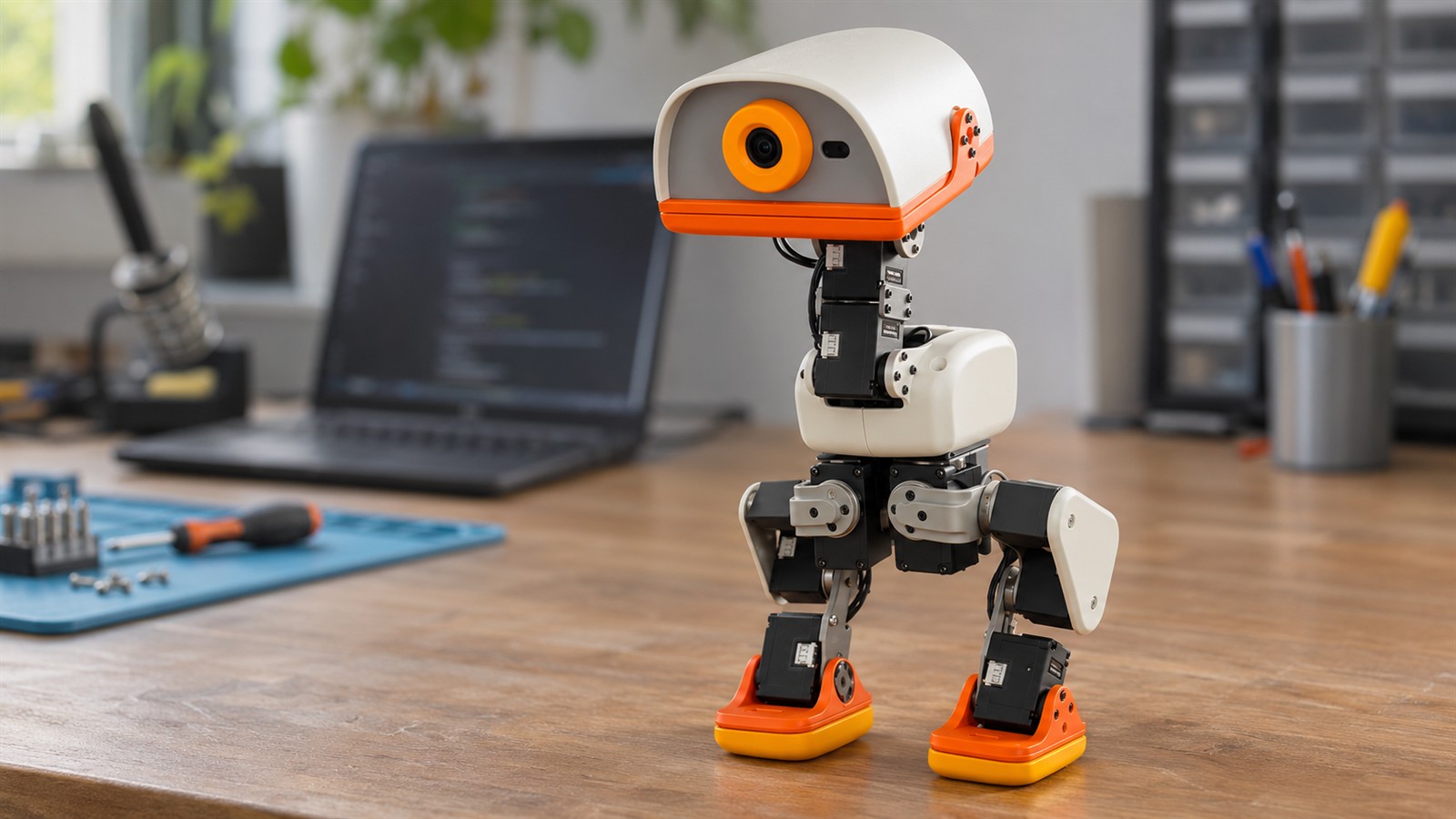
Open-source robotics now spans small walking companions, expressive desktop machines and full humanoid development platforms. Microduck, Reachy Mini, Asimov and ROBOTO Origin demonstrate different approaches to making robots accessible to developers. The significant development is not that a low-cost machine can suddenly complete any household task. It is that more people can investigate the connection between mechanics, control and AI using documented systems.
Before buying, distinguish the claims carefully. Published source code is not a complete assembled robot; a preorder price does not establish immediate availability; and fluent conversation does not prove reliable motion control. This overview uses original project documentation to compare practical development paths. We have not independently tested these devices and do not repeat unverified sales or preorder totals.
Microduck: a small biped for physical AI
Pollen Robotics introduced Microduck in August 2026 as a roughly 25 cm biped with 15 motors. Its original Microduck announcement identifies a camera, a small depth sensor, two inertial sensors and an articulated beak for grasping. The emphasis is on movement, learning and transferring trained behaviour onto real hardware.
The announced entry price is $399 before taxes and shipping. Pollen’s shipping policy still describes a preorder, with first deliveries targeted before Christmas 2026 at the time of this assessment. That is a target, rather than a guarantee that every order placed today will arrive on a specific date. Check the conditions applicable to the actual destination.
The format offers an approachable way to organise experiments in limited space. A useful first project might repeat the same short movement sequence on a defined surface while recording failures. This creates an assessable task rather than a collection of impressive isolated demonstrations. Consistent conditions make improvements easier to identify and easier for another developer to reproduce.
Official manufacturer video: Microduck
The following introduction comes directly from Pollen Robotics’ YouTube channel. It illustrates the product concept; a demonstration does not replace testing under the conditions of a particular project.
Watch the official Pollen Robotics introduction on YouTube
Reachy Mini prioritises interaction
Reachy Mini takes a different approach. The official Reachy Mini documentation describes an expressive platform for human-robot interaction. The Wireless version includes onboard computing and a battery; Lite connects to a host computer over USB. A simulation route is available as well.
Choosing between these concepts begins with the task. A conversational desktop assistant may benefit more from head movement, gaze and audio than from legs. Studying locomotion requires different mechanics and training tools. Neither design is automatically better for every application. Write down the desired behaviour before selecting the body that will perform it.
The original Reachy Mini announcement listed $399 for Lite and $499 for Wireless, excluding taxes and shipping. Those announcement figures are not a current final-price guarantee. Check the actual basket price, lead time and additional computing equipment required for the chosen version before ordering.
Asimov and RoboParty: larger open humanoids
Menlo Research documents Asimov 1 as an open humanoid platform. Its technical overview gives an approximate height of 1.2 m, weight of 35 kg and 25 powered joints. This is a substantially different scale from a desktop companion and calls for an appropriately equipped working area.
RoboParty’s ROBOTO Origin is another platform for developers, research and education. The original ROBOTO Origin documentation describes work spanning hardware drivers, motion control, inference and programming interfaces. For selection, the available documentation and the team’s ability to use it matter more than the general description “humanoid”.
A larger platform can make sense when the goal is whole-body behaviour, manipulation research or the development of a new controller. For an introductory workshop, assess the additional effort carefully. Assembly, wiring, calibration and a suitable test environment are separate jobs. Accessible source code does not remove the cost of those activities or make every platform appropriate for beginners.
What is actually open?
A software function can often be investigated through code and dependencies. A robot adds a bill of materials, mechanical drawings, electronics, firmware and calibration information. The key question is therefore the scope of the release. Can users change only an application, or can they also understand, repair and rebuild the underlying system?
For Microduck, Pollen links separate repositories for robot software and the SDK and for reinforcement learning and sim-to-real tools. Operating a supplied movement and training a new movement policy are different development steps. Their computing, setup and debugging requirements need not be the same.
The Reachy documentation also identifies different licences for software and hardware designs. That suggests a useful check for any project: establish which licence applies to each part and to the intended use. A publicly visible repository does not answer every reuse question. Plan a specific licence review before investing in a commercial design based on published files.
Keep simulation, training and physical operation separate
Simulation helps repeat an experiment under controlled conditions. It does not remove differences in the real machine. Friction, mechanical play, surface properties and sensing errors can behave differently from their simulated equivalents. Moving a behaviour from the model onto the robot is a development stage in its own right, rather than merely copying a file.
A manageable learning sequence starts with an existing example. Record the baseline, change one parameter and compare the outcome. Changing the model, controller and hardware simultaneously makes later faults harder to explain. A small reproducible task frequently teaches more than a complicated scenario that succeeds once and cannot be repeated reliably.
A language model may interpret instructions or propose actions, but joint motion and operating limits still require an appropriate control architecture. Smooth conversation is not evidence that the robot can also walk dependably or carry an object as required. Assess those capabilities separately and give each a clear success criterion.
Version information is essential here. Record the robot hardware revision, firmware, relevant code release and model used for each experiment. A result that depends on an undocumented combination is difficult to reproduce even when every file is publicly accessible. Good project notes are part of the value of an open platform.
The budget extends beyond the robot
Depending on the project, the purchase may be only the beginning. Computing equipment, tools, replacement parts, charging equipment and setup time all belong in the budget. An external AI service may introduce ongoing usage costs. An existing laptop is not automatically sufficient for every training environment, so check the specific guide before committing to hardware.
For a school or team, simultaneous access matters as well. A single robot becomes a bottleneck when several people need to test their changes on the same machine. Combining simulation with scheduled hardware sessions may be more effective than buying a larger device without a clear working method. The useful measure is how many well-documented experiments the team can actually complete.
| Project aim | Relevant platform class | Key question |
|---|---|---|
| Audio, gaze and conversational applications | Reachy Mini | Which processing is local and which uses external services? |
| Legged movement and learned behaviours | Microduck | Do the training setup and hardware revision match? |
| More complex whole-body development | Asimov or ROBOTO Origin | Are facilities, expertise and support time adequate? |
Turn a purchase into a reproducible project
Define an observable result before ordering. “The robot responds to the same command with the specified movement in ten trials” is more useful than “we want to do something with AI”. Decide which data will be recorded, who can access it and how an experiment can be stopped. For a system with a camera and microphone, these are ordinary parts of project planning.
Then establish three simple checks. Can the guide be followed on a fresh system? Does an official example work without modification? Can a small change be reversed? Documenting these steps produces a reusable basis for teaching, research or product development. Published code becomes substantially more useful when another person can follow the same process and understand the result.
Verdict: accessible robotics still needs a clear purpose
Microduck, Reachy Mini and open humanoids offer distinct ways into programmable robotics. Small systems can reduce the initial setup burden, while larger platforms widen the development space. The right choice starts with the learning goal and includes documentation, delivery conditions and total operating effort. A low advertised price helps open the door, but does not create a complete solution for an arbitrary task.
FAQ: open-source robots
Select a question to open the answer.
Is Microduck immediately available?
The reviewed shipping policy describes a preorder with first deliveries targeted before Christmas 2026. The supplier needs to confirm the current timing for a specific order.
Does Reachy Mini walk?
The base platform focuses on desktop interaction. It should be distinguished from Microduck’s two-legged movement concept.
Does open source mean everything is free?
No. Hardware, setup and operation still cost money. The scope and licences of software and design files also need to be checked separately.
Which robot is best for a beginner?
That depends on the task. Start with documented simulation or an official example, then choose hardware that supports that specific learning objective.
Editorial information checked: 4 November 2026. Prices and delivery targets are dated supplier statements. No independent hardware test was conducted. Actual preorder conditions require confirmation from the manufacturer.