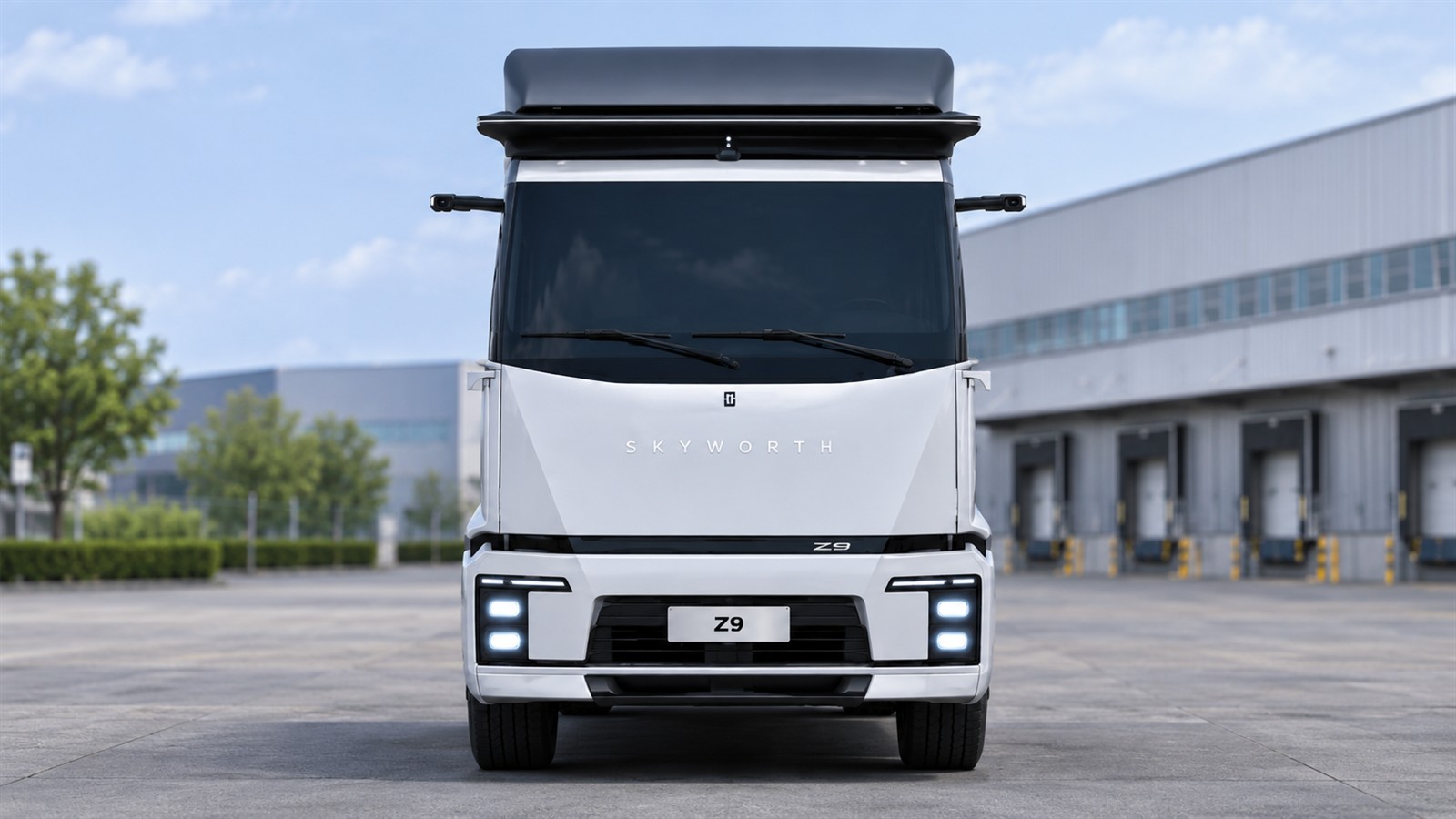
The Skyworth Z9 is an electric tractor unit combining 610 kW of drive power, a 400 kWh LFP battery and an architecture designed for Level 4 automated driving. Presented at IAA TRANSPORTATION 2026, it raises practical questions about how electric heavy vehicles and automation can work together in a defined logistics operation. For a fleet, those questions matter more than the appearance of the dashboard.
The figures need to be kept separate: 610 kW describes power, while 400 kWh describes stored energy. Neither establishes a guaranteed range or a ready-made long-haul business case. This assessment separates published specifications from our own illustrative calculations and explains what a pilot project would still need to demonstrate. It is not based on an independent road test or consumption measurement of the Z9.
Skyworth Z9: the published specifications
The official IAA introduction to the Skyworth Z9 describes a 6×4 electric tractor with a dual-motor system delivering 610 kW and stated peak torque of 1,160 Nm. Energy comes from a 400 kWh LFP battery. Without a clearly identified measurement point, the torque number should not be treated as a directly comparable measure of tractive force at the wheels.
| Item | Published information | What to establish next |
|---|---|---|
| Vehicle | 6×4 electric tractor unit | Approved loads and operating configuration |
| Drive | Dual motors, 610 kW | Power is distinct from battery capacity |
| Battery | 400 kWh, LFP chemistry | Usable energy and operating window |
| Automation | Designed for Level 4 | Defined operating conditions and deployment scope |
| Perception | Five LiDARs, five radars and ten HD cameras | Demonstrated performance in relevant scenarios |
These details are a starting point, rather than a complete procurement specification. The cited announcement does not provide a reproducible loaded consumption test, a usable battery-energy figure or a charging curve. An axle layout alone also cannot establish the payload available in a particular European configuration. Those items belong in the information requested from the supplier.
Why 610 kW is different from 400 kWh
Kilowatts describe the rate at which energy is converted. Kilowatt-hours describe a quantity of energy. A powerful drive can be useful when starting or climbing, but distance depends on energy consumption per kilometre and the energy actually available from the battery. Treating power as a range specification confuses two different engineering questions.
A deliberately simplified example helps explain this. Taking a constant 400 kW from a fully usable 400 kWh store would consume that amount of energy in one hour. This is not a Z9 operating profile. On an actual route, demand and energy recovery vary continuously, while auxiliary systems and battery operating limits affect the result. The nominal pack capacity need not equal the energy available for a planned journey.
A tender should therefore go beyond the highest power figure. Ask for repeatable measurements using the intended trailers, typical loads, waiting periods and heating or cooling requirements. Comparing those results with an existing vehicle provides a far better basis for a decision than comparing headline specifications in isolation.
Range: a calculation is not a vehicle test
The short IAA introduction does not establish an independently measured Z9 range. The following table is our own sensitivity exercise. It divides a nominal 400 kWh by three hypothetical constant consumption rates, assuming all that energy could be used. The selected numbers are illustrative inputs, not a predicted operating band or a promise about this truck.
| Hypothetical consumption | Calculated distance |
|---|---|
| 100 kWh per 100 km | 400 km |
| 125 kWh per 100 km | 320 km |
| 160 kWh per 100 km | 250 km |
The useful lesson is how strongly consumption changes the answer. Reserve, ageing, temperature and operational charging limits are not included. Taking one of these distances and publishing it as the Z9’s range would therefore be misleading. For a dispatcher, the relevant question is whether the least favourable regularly occurring duty cycle can be completed with sufficient margin.
A pilot should cover more than one favourable demonstration day. Record traction energy, auxiliary demand, charging losses and waiting separately where possible. Keep the duty cycle and loading information alongside those measurements. Otherwise an apparent vehicle improvement may simply reflect an easier route or a different load.
Level 4 requires a defined operating domain
The SAE description of Level 4 concerns automated driving under defined conditions, with no human driving needed to mitigate risk. It does not mean unrestricted operation on every road in every weather condition. The operational design domain is central to the claim.
For procurement, request a written account of permitted routes, speeds, weather and traffic situations. The response to roadworks, sensor faults or a communication interruption needs to be clear as well. A vehicle can be valuable in a carefully bounded process without replacing every activity performed by a conventional long-haul tractor.
The IAA 2026 press-day summary identifies ports, steel mills, rail yards and logistics corridors as intended Z9 applications. Such environments offer possible starting points for repeatable transport tasks. That description does not establish approval for a particular facility or public-road route.
Define responsibility for each transition in the process. A loading area, a gate and an ordinary road can impose different requirements even within one journey. The operating concept needs to show where automation begins, where it ends and what happens when the planned conditions no longer apply. A broad label is insufficient for organising that handover.
Sensor numbers are only the beginning
LiDAR, radar and cameras supply different kinds of environmental information. A component count helps describe the architecture, but says little by itself about reliable recognition and response in difficult situations. On a logistics site, small obstacles, occluded people and changing light may matter more than the number of devices fitted around the cab.
A useful acceptance exercise therefore uses explicit scenarios: a container outside its marked position, an unexpected stop by another vehicle, or a dirty lane marking. Agree the expected behaviour, stopping criteria and recording method before the trial. Successfully completing an ordinary demonstration loop is too narrow an assessment of a production process.
Maintenance needs the same attention. Who inspects and cleans the sensing surfaces? How is a damaged mounting detected? When must calibration be repeated? The answers help turn a demonstration into a dependable working routine. Adding more cameras does not remove these operational tasks or establish availability under all conditions.
Plan charging with dispatch, not separately
Battery size must be assessed together with the charging window. Replenishing a hypothetical 240 kWh would take 72 minutes at an average 200 kW, or 48 minutes at an average 300 kW. Both calculations ignore losses and auxiliary demand. They are not Z9 charging claims: actual performance depends on the truck, its charge level, temperature and the infrastructure.
A charger’s peak rating cannot establish the average power delivered throughout a session. Site connection capacity, occupied bays and vehicle arrival order all affect the operation. If several trucks return together, load management may influence the timetable more than nominal battery capacity does. The relevant charging plan is the one that works on a busy day.
Include a failure scenario. Which vehicle covers the task when a charger is unavailable? Can a shift move, and what minimum state of charge is required before the next assignment? Answering those questions in advance makes the process assessable and avoids leaving every disruption to improvised decisions during a working shift.
From technology announcement to business case
Without a supplier quotation, there is no sound basis here for a German purchase price or a universal payback period. Total cost needs to include acquisition, financing, infrastructure, energy, maintenance, training and downtime. An automated workflow also brings integration, supervision and support requirements. Savings must come from the actual process rather than from an assumption that automation removes all labour.
Start with one appropriate transport task. Establish today’s cost, cycle time and availability, then measure the same task in the pilot. Log interventions and interruptions alongside completed journeys. A system requiring frequent support may have a very different organisational effect from the one implied by a smooth demonstration.
- Confirm the precise vehicle configuration, loads and deployment conditions.
- Measure consumption and charging over realistic duty cycles.
- Define the operating domain and the response to faults.
- Agree service coverage, replacement parts and recovery after an interruption.
- Judge success using recorded operating results and a consistent baseline.
Verdict: a relevant platform, not yet a complete investment case
The Skyworth Z9 brings a strong electric drive together with an extensive perception architecture. That makes it relevant to the investigation of automated logistics processes. Whether it fits a fleet depends on its operating limits, charging arrangements and demonstrated availability. The correct technical starting point is 610 kW of power and a 400 kWh battery. The remaining decisions require a specific offer and a properly documented pilot.
FAQ: Skyworth Z9
Select a question to open the answer.
Does the Z9 have a 610 kWh battery?
The official IAA introduction specifies a 400 kWh battery. The 610 kW figure describes drive power.
What is the confirmed range?
The cited short introduction does not provide a reproducible range test with operating conditions. The calculations in this article are not measured Z9 results.
Does Level 4 work everywhere?
Level 4 applies within defined operating conditions. Each deployment needs its operating domain, organisational requirements and necessary approvals clarified.
Is there a confirmed German purchase price?
The original sources assessed here do not establish a binding German purchase price. An investment decision requires a specific supplier quotation.
Editorial information checked: 4 November 2026. Technical figures come from the linked original sources. All illustrative calculations are editorial models and are not measurements of the Skyworth Z9.