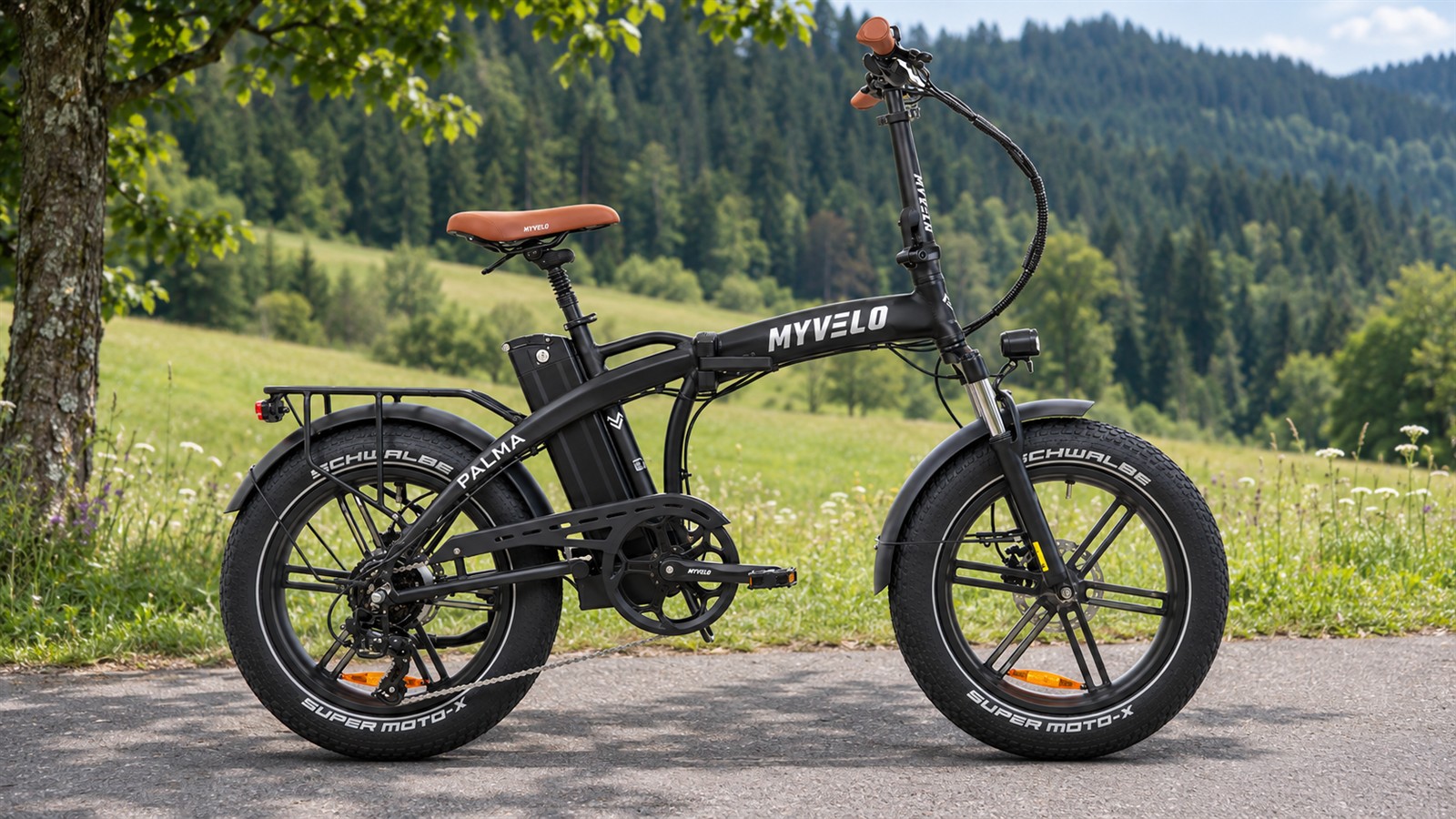
The MYVELO Palma combines a large 950 Wh battery with a folding frame and wide 20-inch tyres. It is an electric fat bike for riders who want a touring companion that can be packed away, while accepting a substantial amount of weight. On 4 November 2026, the German manufacturer’s shop listed it at €2,649 including VAT. However, the selected configuration was marked as sold out during our research. Price, availability and the exact specification therefore need to be checked together before ordering.
The obvious question is what that battery capacity means on the road. Equally important are the effort required to load the bike into a vehicle, its step-over height and its real storage dimensions. This article assesses published manufacturer information and adds clearly labelled calculations and practical buying checks. We have not conducted our own road test or measured the Palma’s range. Prices and sales conditions discussed here concern the German market, rather than a confirmed offer for other countries.
MYVELO Palma: price and key specifications
The table summarises the main figures on the current MYVELO Palma product page. These are manufacturer specifications for the advertised configuration, rather than values independently measured by this publication.
| Item | Manufacturer information |
|---|---|
| German shop price | €2,649 including VAT; selected configuration marked sold out when checked |
| Battery | 48 V, 19.8 Ah, approximately 950 Wh |
| Drive | Bafang rear hub motor, 250 W; stated torque of 80 Nm |
| Gears and brakes | Seven-speed Shimano transmission; hydraulic Tektro disc brakes, 160 mm |
| Wheels and tyres | 20-inch wheels with wide Schwalbe tyres |
| Weight | 26.5 kg excluding the battery |
| Step-over height and payload | 75 cm; stated payload of 130 kg |
| Charging time | Approximately seven hours |
When comparing bikes, make sure the numbers describe the same thing. A weight excluding the battery cannot be compared directly with another bike’s complete ready-to-ride weight. Likewise, payload is not another name for the maximum permissible combined weight of bicycle, rider and luggage. Ask the seller to identify both limits clearly for the precise version being supplied.
What a 950 Wh battery actually tells you
Multiplying nominal voltage by charge capacity gives a useful approximate energy calculation: 48 V multiplied by 19.8 Ah equals 950.4 Wh. The rounded battery specification is therefore arithmetically consistent. Watt-hours describe stored energy; watts describe power at a particular moment. A larger battery does not, by itself, establish a higher permitted assistance speed or stronger acceleration.
MYVELO also identifies a 950 Wh pack on its replacement battery page for the Rio and Palma. Exact version compatibility still matters when ordering a replacement. The connector, locking arrangement, physical shape and manufacturer’s approval need to match the existing bicycle. An identical voltage on its own is insufficient evidence that two batteries are interchangeable.
Additional stored energy can support longer rides or reduce charging stops over the same daily distance. Whether that benefit outweighs the handling burden depends on the rider’s routine. Someone with convenient charging after every trip may value extra capacity differently from a traveller trying to cover several days without a dependable socket. Start with that practical requirement rather than assuming the largest pack is automatically the best choice.
Range claims: why 170 km is not a planning guarantee
The product page advertises up to 170 km per charge. A separate MYVELO fat-bike comparison lists 80 km for the Palma with the same 950 Wh capacity. These figures do not establish a single documented, comparable test result. Neither should therefore be presented as a guaranteed everyday range.
The calculations below illustrate how strongly energy consumption changes the result. They simply divide a nominal 950 Wh by chosen hypothetical consumption rates. They are not Palma measurements, a predicted range interval or evidence that all the nominal energy can be used on a real ride.
| Hypothetical consumption | Calculated distance from 950 Wh |
|---|---|
| 6 Wh/km | Approximately 158 km |
| 10 Wh/km | 95 km |
| 15 Wh/km | Approximately 63 km |
Covering 170 km from a nominal 950 Wh would require an average of approximately 5.6 Wh per kilometre in this simplified calculation. That tells us the scale of energy consumption implied by the advertising figure. It does not show that a particular rider will achieve it. Battery reserve, available capacity, temperature and operating conditions are outside the scope of the division.
For an initial longer outing, choose a loop with opportunities to shorten the route rather than riding to a theoretical limit. Record distance, assistance setting, luggage, terrain and the remaining battery indication. Several comparable rides are more useful for personal planning than a single unusually favourable trip. Leave room for the return journey to involve conditions different from those on the way out.
Folding dimensions: clarify two conflicting specifications
The product page gives two different folded sizes. Its folding section states 105 × 62 × 80 cm, while the technical list states 110 × 52 × 79 cm. The page does not clearly explain whether those differences reflect measurement methods or different versions. They matter when storage space is tight. Obtain confirmed dimensions for the exact bike to be delivered before relying on either set.
A simple physical check can prevent an expensive mismatch. Mark the proposed footprint with tape or cut a cardboard template, then check the height and the route to the storage location. A large enough luggage compartment is not sufficient if the bicycle will not pass through the narrowest opening. In a car, account for the loading lip, rear seat position and all the bags that must travel with it.
Test folding and lifting as one complete task. A folding mechanism can operate easily while the resulting bundle remains awkward to hold. Ideally, practise with a comparable vehicle and the actual transport bag you intend to use. Ask the seller to demonstrate suitable lifting points and how to secure the folded sections. Do not treat cables, mudguards or other unsuitable components as convenient handles.
Weight and step-over height shape everyday use
The stated 26.5 kg before adding the battery already makes clear that this is not lightweight hand luggage. If stairs are part of your daily journey, a realistic lifting trial should carry more weight in the decision than a quick folding demonstration. Level storage and an accessible charging point can make a considerable difference. A suitable loading ramp may also help in a travel setup, provided its capacity and compatibility are checked.
Small wheels do not automatically produce an easy step-through frame. MYVELO’s step-over height comparison lists 75 cm for the Palma and 41 cm for the related Rio. Riders who find lifting a leg difficult should try the frame shapes in person. The useful test is whether mounting, stopping and dismounting feel manageable with normal footwear and clothing.
Consider the whole sequence of a typical journey: remove the bicycle from storage, prepare it, ride, park, fold it and load it again. If one repeated step is uncomfortable, a feature that looks attractive on a specification sheet may not solve the actual problem. Doing this sequence once during a viewing is more informative than looking only at the bike while it stands unfolded.
Assessing the tyres, motor and riding position
Wide tyres, a suspension fork and a suspended seatpost form a recognisably comfort-focused concept. That combination alone cannot establish whether an individual rider will like the handling. A useful test ride should include slow turns, starts, a narrow passage and an uneven section. Check whether the saddle, handlebar and brake lever positions can be adjusted appropriately.
Tyre pressure should not be chosen from a generic comfort claim alone. The limits on the fitted tyre and rim, together with the approved loading conditions, need to guide the setup. An unsuitable pressure can change how a bicycle behaves. Ask for a specific starting setup for rider and luggage rather than copying one advertising number without considering the actual equipment.
Motor power and a torque figure are also no substitute for a relevant hill trial. On the intended route, the important questions are whether starting with luggage feels controlled and whether assistance is easy to modulate. Include some riding at a low assistance setting. This helps reveal whether gearing and riding position suit the task before battery size dominates the decision.
A practical buying checklist
- Confirm the exact model version, battery version and fitted tyres.
- Ask whether the €2,649 offer is available again and obtain a delivery estimate.
- Request the complete weight with battery and intended accessories.
- Confirm folded dimensions and test the narrowest opening on the transport route.
- Clarify separate limits for rider, luggage rack and other accessories.
- Identify who will handle servicing, replacement parts and any after-sales issues.
Read the manual for the actual version as well. MYVELO provides a Palma document on its instruction-manual download page. Ask whether the available edition matches the offered bicycle. A clear demonstration of the folding lock, battery removal and brake operation offers practical value beyond a long list of general equipment claims.
Keep the confirmed specification with the quotation. This gives both buyer and seller a common reference if a photograph, marketing paragraph or older document describes a different component. For a bicycle bought primarily for travel, include storage and transport requirements in the discussion from the outset rather than discovering a mismatch after delivery.
Verdict: a touring option when carrying is limited
The Palma is a plausible candidate when a substantial battery, wide tyres and a frame that folds for transport are all required together. Riders facing frequent stairs or particularly confined storage should explicitly compare lighter and smaller alternatives. The deciding factor is the journey and its repeated handling tasks, rather than the biggest number in the specification.
Before ordering, resolve three matters: a confirmed quotation and delivery situation, the conflicting folded dimensions, and a successful practical trial of mounting, folding and lifting. Those checks provide a sounder basis for weighing the benefit of 950 Wh against the bicycle’s size and mass.
FAQ: MYVELO Palma
Select a question to open the answer.
Does the MYVELO Palma have a 1,000 Wh battery?
The current manufacturer specification is approximately 950 Wh. Multiplying 48 V by 19.8 Ah gives 950.4 Wh. Describing this as almost 1,000 Wh does not identify a different battery size.
Is 170 km of range guaranteed?
No. The manufacturer advertises an up-to figure and gives 80 km in a separate comparison. Personal route planning needs experience under relevant conditions and a reserve.
Is it suitable for carrying every day?
A lifting trial should decide that. The stated weight is already 26.5 kg without the battery, making a comparison with lighter bikes especially useful for regular stair use.
Which folded dimensions are correct?
The product page lists both 105 × 62 × 80 cm and 110 × 52 × 79 cm. Ask MYVELO to confirm the dimensions of the precise version being delivered before ordering.
Editorial information checked: 4 November 2026. Prices and availability refer to the German manufacturer’s shop at the time of research. Technical figures come from the linked manufacturer documents; calculations are explicitly identified as examples.