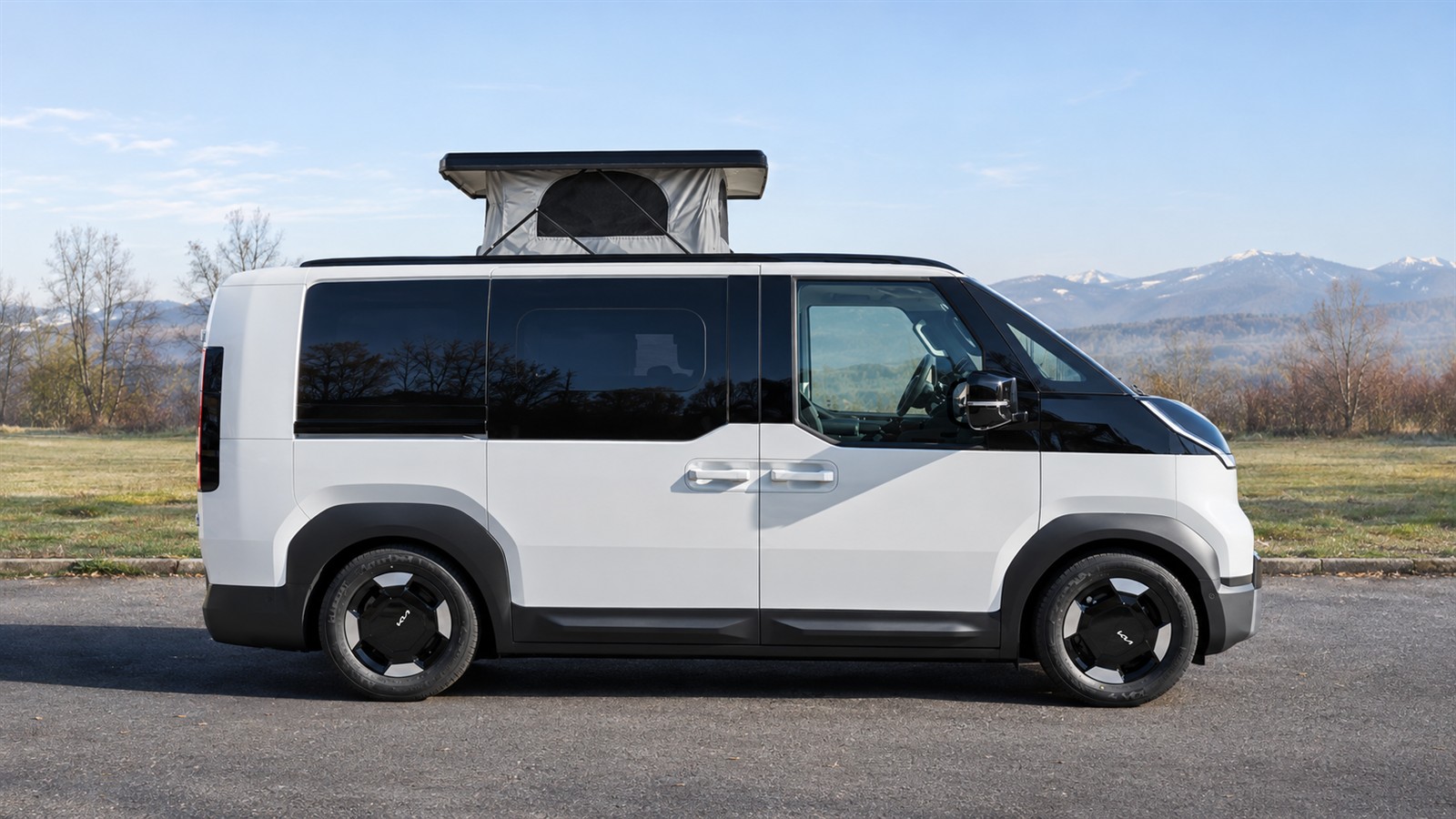
The Kia PV5 camper by Alpincamper combines an electric van with a bed, kitchen and compact camping conversion. Kia supplies the base vehicle, while the conversion comes from the company in Lenggries, Germany. The result is a small camper for everyday use and travel, whose usefulness depends mainly on the roof, battery, payload and complete specification. Anyone considering an electric camper with a budget of around €53,000 should examine these points separately.
A low price alone does not make a vehicle suitable for travelling. What matters is how many people can travel in it, where they sleep and which electrical appliances they need. This article reviews the published manufacturer information and adds a practical buying checklist. We have not independently road-tested, range-tested or spent a night in the converted vehicle. Prices and specifications discussed here refer to the German market.
Kia PV5 camper: Korean base vehicle, Bavarian conversion
Alpincamper uses the Kia PV5 Cargo as its starting point. The converter lists an overall length of about 4.70 metres, two seats and a conversion with an extendable bed, kitchen unit and coolbox. A Reimo lifting roof is listed as an option. This is a specific conversion of a production vehicle and should be distinguished from other PV5 versions and concept vehicles. Source: Alpincamper, Kia PV5 Camper.
This distinction also helps when comparing offers. A PV5 Passenger with a removable bed module serves different requirements from a Cargo with fixed furniture. A show vehicle may include equipment absent from the cheapest offer. Ask for a complete description of the exact vehicle that will actually be delivered.
Price check: does the Kia PV5 camper cost around €53,000?
The Alpincamper product page checked for this article does not state a binding complete-vehicle price of €53,000. It lists individual conversion options and links to dealer offers. That does not establish a universal final price for every combination of battery, roof and equipment. A figure in this region is therefore a budget to investigate, rather than a confirmed offer for one clearly specified configuration.
Kia Germany currently quotes a starting price of €36,290 including VAT for the unconverted PV5 Cargo. This is not the price of a finished camper and does not automatically cover the desired battery or equipment level. Source: Kia Germany, PV5 Cargo.
A useful comparison requires at least five items: base vehicle, camping conversion, roof, optional equipment and delivery. Include the costs of the intended registration and any required inspections. Obtain explicit confirmation that taxes, delivery charges, charging cables and all the advertised camping functions are included. A total without an equipment schedule is not enough for a reliable comparison.
Technical basis: battery, dimensions and charging
Kia’s January 2026 press kit describes the long PV5 Cargo version and its powertrain options. The following figures relate to the base vehicle. Range and dimensions after conversion need to be considered separately. Source: Kia, PV5 Cargo press kit.
| Feature | Published figure for the Cargo base vehicle | What camper buyers should check |
|---|---|---|
| Length and width | 4,695 × 1,895 mm | Dimensions including mirrors and fitted accessories |
| Batteries in the versions described | 51.5 or 71.2 kWh | The exact battery included in the camper offer |
| Maximum combined WLTP range | Up to 416 km | Not an independently measured range for the conversion |
| DC charging time | 10–80% in around 30 minutes under the stated conditions | Temperature and charging equipment affect real-world results |
A larger battery can provide more flexibility for driving and appliances. It does not replace suitable trip planning. Someone taking mostly short weekend trips will assess charging stops differently from someone regularly covering long distances in a day. The important thing is not the largest brochure figure but a package that suits your use and budget.
Lifting roof or sleeping roof: an important difference
A small lifting roof primarily creates an area where you can stand and ventilate the interior. A sleeping roof also needs a purpose-designed bed platform and suitable access. The terms should not be used interchangeably. The choice affects daily life inside the vehicle, the price and the ability to accommodate more people overnight.
Alpincamper lists the lifting roof for additional standing room as a €3,500 option. The order should state whether the vehicle includes this roof or a different solution. An extra sleeping space also does not automatically mean extra approved travelling seats.
During a viewing, try the whole sequence: raise the roof, stand beneath it, convert the seating into a bed and return everything to driving mode. Check where bedding and luggage go during each step. A conversion works well in everyday use when these tasks do not require constant rearranging.
Interior: compact dimensions require clear priorities
The conversion overview lists a bed that extends to approximately 1.20 × 1.95 metres, a sink, an induction hob and a compressor coolbox. Fresh-water and waste-water tanks are each listed at twelve litres. This arrangement suits a compact vehicle but requires deliberate planning for longer stays.
A practical trial tells you more than looking through the sliding door. Both travellers should lie on the bed. Check shoulder and foot space and whether it is possible to get out during the night. Also consider whether cooking and sitting can happen at the same time or whether parts of the interior must first be rearranged.
For water, make your own consumption list. Drinking, cooking, handwashing and washing dishes draw on the same supply unless separate drinking water is carried. A tank capacity in a brochure does not establish how long two people can manage. A short trial trip provides a better answer than a general claim about off-grid independence.
V2L: understanding power from the traction battery
Vehicle-to-Load allows suitably equipped PV5 vehicles to run electrical devices from the traction battery. Kia describes interior sockets and an external power supply. This is useful in a camper, for example for small household appliances. Nevertheless, confirm the equipment and maximum simultaneous load for the exact vehicle.
A large traction battery is not an unlimited camping socket. Electricity used for cooking, heating or cooling is no longer available for driving. Conversion losses and a selected cut-off reserve also matter. Ask to see which functions are available while parked, how they are activated and when they switch off.
A simple calculation illustrates the relationship: a device averaging 100 watts uses one kilowatt-hour over ten hours. A 1,000-watt appliance uses the same energy in one hour. This is not a measurement from the PV5 but a basic energy calculation. High connection power and long operating time are separate issues.
For travel planning, build a daily energy budget for the coolbox, cooking, lighting and other devices. Add the driving reserve you want the next morning. Only then can you judge whether mains hook-up is convenient, regularly necessary or unnecessary for the planned trip. The purpose and charging paths of an additional camping battery should also be clear from the wiring diagram.
How much range remains after conversion?
The production vehicle’s WLTP figure is a comparison value obtained under defined conditions. Furniture, roof modifications, luggage and travelling speed can change the result. A credible range figure for the camper therefore requires a test drive with the offered specification. A short city run is not enough if most future journeys will be on motorways.
Start by planning a typical trip: distance to the first destination, desired reserve and possible charging locations. Then check whether suitable chargers are accessible with the vehicle. A bicycle rack, luggage or trailer may affect access and parking. A short charging time is of little help if the intended charger is unavailable on your route.
A useful practical test therefore combines a mixed driving route with a stay using the normal appliances. Record charge level, distance, weather and use. These observations provide a personal planning basis. One unusually favourable or unfavourable journey should not be treated as general proof of range.
Clarify payload and warranty before buying
For any camper, the completed travelling vehicle is what counts. Request an up-to-date weight including fixed furniture and ordered extras. Travellers, water, bicycles and luggage are added afterwards. Axle loads and carrier limits must also suit the intended use. Where figures are unclear, documented weighing is more useful than a general number on a model page.
Kia generally advertises a seven-year manufacturer warranty up to 150,000 kilometres, subject to conditions and exclusions. For high-voltage batteries from model year 2026, it lists eight years or 160,000 kilometres. This does not automatically provide the same cover for all furniture, roof components and installations in a camping conversion. Source: Kia Germany, warranty overview.
Ask for a written explanation of responsibilities between the vehicle manufacturer, converter and roof supplier. It is particularly useful to know who examines a fault first and who coordinates repairs. When travelling, access to help, diagnostics and spare parts matters alongside the underlying entitlement to cover.
Official Kia video about the PV5
The following video comes from the official Kia Worldwide channel and explains the thinking behind the PV5. It covers the base vehicle and platform concept; it does not guarantee the equipment of the Alpincamper conversion.
Watch on the official Kia channel.
Buying checklist: what the quotation should include
- Clearly identify the base vehicle, model year, battery and equipment.
- List roof type, approved travelling seats and actual sleeping spaces separately.
- Specify the conversion, electrical supply, water system and requested extras.
- Confirm the total including taxes, handover and required inspections.
- Document weights, warranty conditions and service responsibilities.
- Arrange a test drive and a complete demonstration of living and bed conversion.
The PV5 camper is particularly interesting for buyers seeking a compact vehicle for both daily life and travel. Whether the electric conversion is right for you depends on realistic driving stages, suitable charging and an interior that fits its occupants. A complete quotation and a thorough functional trial matter more than a single starting price.
FAQ: the Kia PV5 camper by Alpincamper
Select a question to open the answer.
Is the Alpincamper a motorhome built directly at Kia’s factory?
Kia supplies the PV5 Cargo base vehicle. Alpincamper in Lenggries provides the camping conversion described here. The quotation should describe vehicle and conversion separately.
Is €53,000 a confirmed complete price?
The checked Alpincamper product page does not state this as a binding complete price. An up-to-date quotation specifying battery, roof and full conversion is essential.
Will the finished camper cover 416 kilometres?
Up to 416 kilometres is Kia’s WLTP figure for the Cargo base vehicle. It is not a separate range test of the converted camper.
Can you sleep in the lifting roof?
A small lifting roof primarily provides standing room and ventilation. A sleeping roof needs a purpose-designed bed. Confirm the exact roof configuration before ordering.
Editorial date: 4 November 2026. Product figures come from the linked manufacturer information. Confirm prices, equipment and availability against the specific quotation.