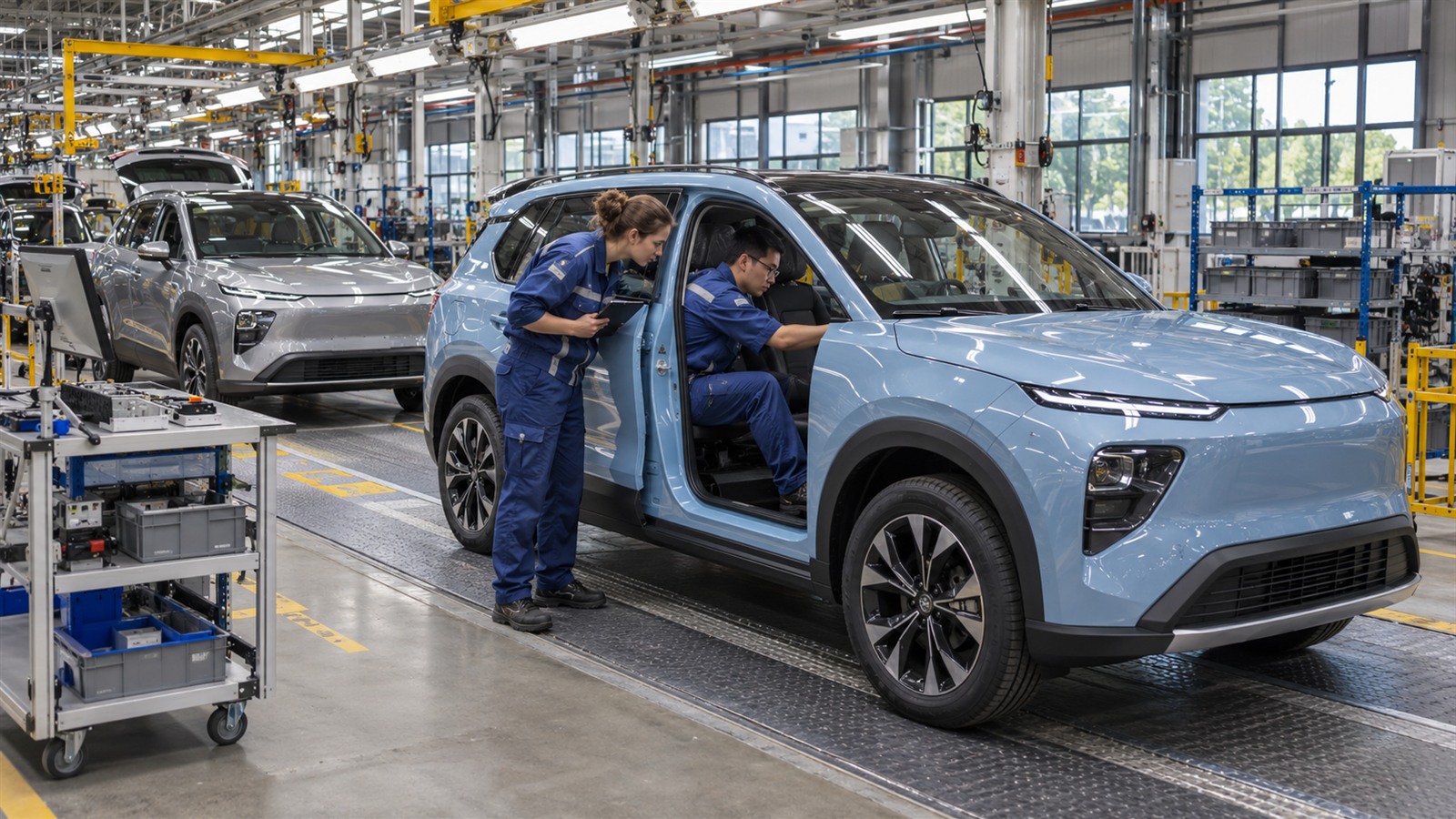
Opel, Stellantis and Leapmotor represent a new industrial division of labour in the electric-car market. European brands, existing factories and Chinese technological expertise are to work more closely together. The key measure is not simply the country behind a logo, but where development, production and economic responsibility actually lie.
The partnership could strengthen existing factories and bring new vehicles to market faster. It also raises questions about brand identity, regional value creation and long-term dependency. Suppliers and engineering companies particularly need to know which services will be required locally and how firm the announced projects already are. Updated: 4 November 2026.
Opel and Leapmotor: what Stellantis officially announced
In their statement of 8 May 2026, Stellantis and Leapmotor described their intended partnership expansion. An additional line for a new electric Opel C-segment SUV was being considered for Figueruelas near Zaragoza, with a possible production start in 2028. Manufacturing the Leapmotor B10 at the site was also part of the plans. Procurement through Leapmotor International was to be deepened as well. The statement made the broader collaboration subject to final agreements and customary approvals. Source: Stellantis on the expanded Leapmotor partnership.
The corporate structure matters: Leapmotor International was described as a joint venture owned 51 per cent by Stellantis and 49 per cent by Leapmotor. This operating joint venture must be distinguished from Stellantis’s direct stake in the Chinese manufacturer. Different percentages therefore refer to different companies. Ownership alone does not explain the division of tasks on an individual vehicle project.
Why European plant utilisation is becoming a strategic issue
At its Investor Day on 21 May 2026, Stellantis set a target of improving European industrial utilisation from 60 to 80 per cent. Total installed capacity was also to fall by 800,000 units. These figures concern the stated European strategy, not a site-specific utilisation measurement for Zaragoza. Source: Stellantis Investor Day 2026, Enlarged Europe (PDF).
The distinction is essential. Better utilisation can result from more production, but also from reducing available capacity. The metric alone therefore does not mean that every factory is building more vehicles. A sound assessment must state production volume, the capacity base and the period together.
Additional models can make better use of existing equipment. However, investment, workflows and demand must align. A new vehicle is economically especially useful when it makes a sustainable contribution after its additional costs. Higher volume without sufficient revenue would merely postpone the fundamental profitability question.
Shared technology and a distinct brand must work together
Sharing components in car manufacturing is generally a way to spread development and procurement across larger volumes. For customers, what the finished vehicle offers remains decisive. Usability, comfort, design, service and trust in the brand shape purchasing decisions. Technical cooperation must therefore translate into a coherent overall product.
An Opel using shared technology should not be judged solely by where its components originate. Nor is every in-house development automatically economically superior. What matters is which characteristics the manufacturer takes responsibility for and how well the vehicle fits its customers. Clear development objectives and reliable coordination with the partner are necessary.
This can change the role of engineering service providers. Integrating existing technology may become more important than developing all the foundations independently. This includes aligning requirements, checking interfaces and documenting the finished product. The value lies in a functioning overall system, even when individual building blocks come from outside.
How much European value creation does the vehicle contain?
The assembly location is an important part of industrial value creation, but not a complete description. Development, component manufacturing, software, logistics and ongoing support also matter. A car assembled in Europe can contain varying shares of regional and imported work. Without relevant data, the local share cannot be credibly quantified.
Additional manufacturing can nevertheless matter to the region. Employment, supplier orders and local investment are concrete economic factors. Whether these effects are large or small depends on the work actually awarded. Equating European assembly with entirely European technology would obscure those differences.
A supplier’s headquarters do not resolve every origin question either. A European company may source inputs from other regions. Conversely, an international group may develop and manufacture locally. Assessing the actual value chain is therefore more useful than assigning one nationality to the entire vehicle.
Battery production and vehicle cooperation are separate projects
The industrial context also includes the Zaragoza battery project announced by Stellantis and CATL on 10 December 2024. That statement cited investment of up to €4.1 billion in a joint LFP battery factory and potential capacity of up to 50 gigawatt-hours. Expansion was tied to market conditions and public-sector support. These historical planning figures do not confirm annual production already achieved today. Source: Stellantis and CATL on the battery investment.
The battery project should not be confused with the Leapmotor collaboration. They involve different partner arrangements, objectives and timetables. Physical proximity may enable industrial benefits, but does not establish a complete supply allocation for every announced model. That would require further specific disclosures.
What European suppliers should examine now
A supplier first needs to establish who actually purchases the service and which organisation approves it. With several companies involved, requirements and contacts can differ. Clearly allocating development, series procurement and later changes prevents quotations from missing the real decision-making chain.
The firmness of volumes is equally important. A model announcement is not yet an individual order. Before investing in additional capacity, call-offs, payment terms and procedures for delays should be clear. This cannot prevent every market fluctuation, but provides a stronger basis for staffing and material decisions.
New partnerships can also change price comparisons. Suppliers need to explain the measurable benefit they provide beyond a component price. This includes quality, available capacity, efficient coordination and reliable support. Such services remain relevant even when the international origin of the underlying vehicle technology changes.
How the Opel–Leapmotor partnership’s success will become visible
A useful measure combines three levels: is a competitive vehicle created, can it be manufactured reliably, and does it produce an economically sustainable business? A convincing answer to just one is insufficient. A good product without a robust supply chain is as problematic as a well-utilised line without enough customer demand.
The partnership thus represents a European industry seeking to combine existing strengths with external technology. Actual production launches, customer responses and business results will show whether it creates lasting success. For the wider competitive context, our article on China’s automotive industry and overcapacity explains why production potential and sales should be considered separately.
FAQ: Opel, Stellantis and Leapmotor
Select a question to open the answer.
What is planned for a new electric Opel SUV?
In May 2026, Stellantis described a new electric C-segment SUV for production in Figueruelas, potentially starting in 2028. The announcement made the timetable and broader cooperation conditional.
Is Leapmotor International wholly owned by Stellantis?
No. Under the published structure, Stellantis holds 51 per cent and Leapmotor 49 per cent of the joint venture. This must be distinguished from a direct stake in the Chinese manufacturer.
Does manufacturing in Europe automatically mean entirely European technology?
No. Assembly, components, software and development can come from different regions. Establishing the local value-creation share requires specific data on the relevant chain.