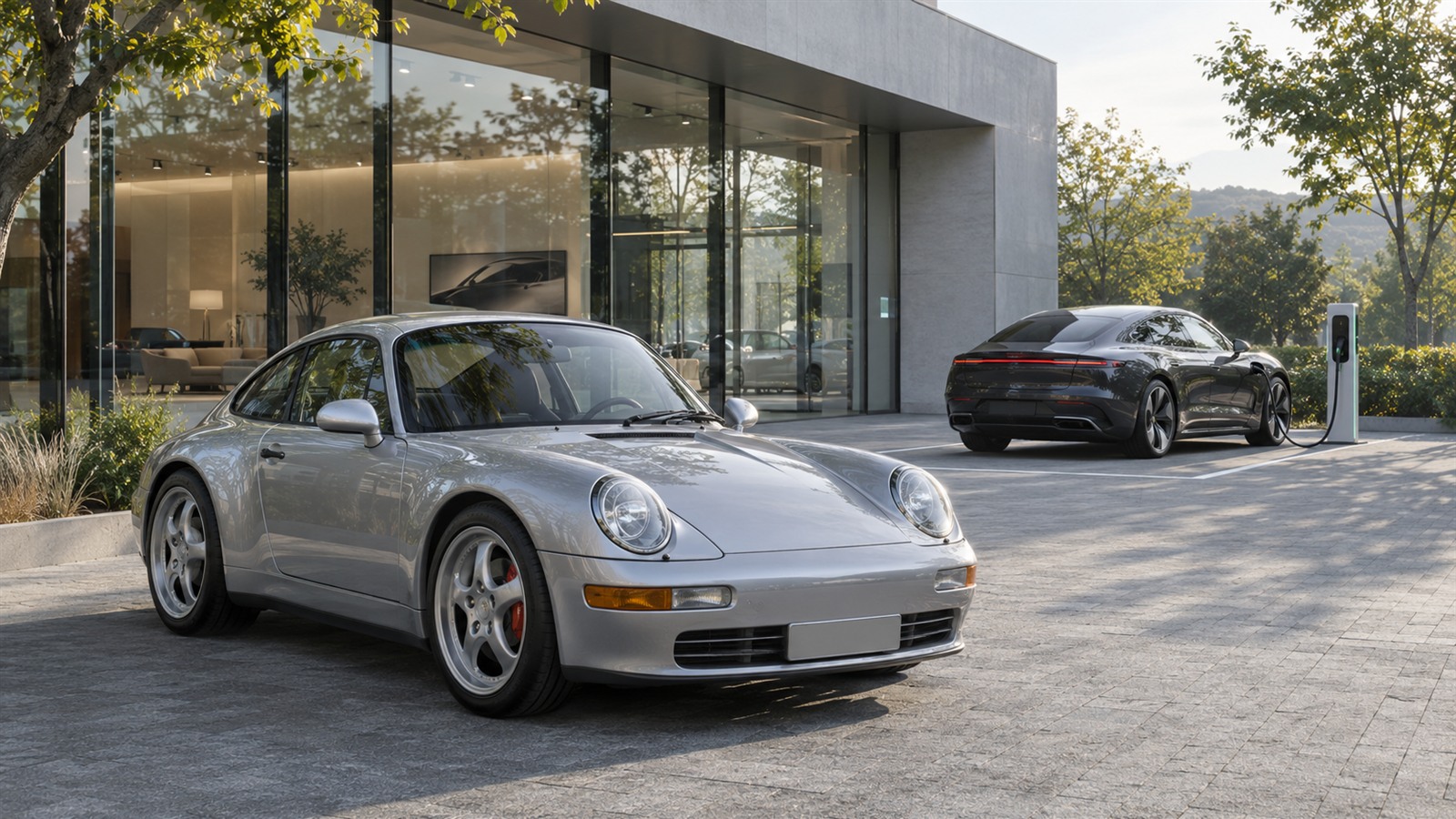
The Porsche 911 is growing in 2026 against the brand’s overall sales trend. For Porsche, this is an important signal of the strength of exclusive sports cars. It does not, however, settle the question of the right powertrain mix. The strategic task is to restore a sustainable relationship between desirability, costs and the product offering.
Reading the successful 911 as direct evidence against electric cars overlooks several differences: model ranges serve different customers, occupy different points in their life cycles and are not equally available everywhere. Moreover, electric assistance and combustion engines now coexist within the 911 family itself. This article puts the official figures and new strategy into perspective. Updated: 4 November 2026.
Porsche deliveries in 2026: the 911 stands out
On 9 October, Porsche reported 178,532 worldwide deliveries for the first nine months of 2026, down 16 per cent year on year. The 911, by contrast, gained twelve per cent. All the following figures refer to January–September 2026, avoiding comparisons between different periods.
| Model range or whole brand | Vehicles | Year-on-year change |
|---|---|---|
| Porsche total | 178,532 | −16% |
| 911 | 42,217 | +12% |
| Macan, all powertrains | 51,025 | −21% |
| Taycan | 8,699 | −31% |
Of the Macan total, 23,029 vehicles were the fully electric version. Porsche also points to gaps in its offering and the end of production of previous models. Delivery figures alone therefore cannot attribute the decline conclusively to a single cause. Source: Porsche on deliveries after nine months of 2026.
Why the model mix explains more than a powertrain debate
A traditional sports car and an electric everyday vehicle can meet very different expectations under the same brand. Buyers attach different importance to space, usage, design and emotional value. Sales of two model ranges are therefore not a controlled experiment on powertrain type. The products and their market conditions differ too much.
Availability over time also matters. If an existing version disappears before its replacement is fully available, sales may temporarily decline. This does not directly establish long-term demand for the new offering. A meaningful assessment requires the context of product life cycle, region and versions actually offered.
The 911’s strength is nevertheless economically relevant. It shows that individual products can develop differently within a difficult overall market. Porsche’s task is to understand successful attributes more precisely. Which can be transferred to other models, and which depend specifically on one range’s distinctive history?
The 911 is not a blanket alternative to electrification
Porsche introduced the 911 Carrera GTS with T-Hybrid in 2024. Its combustion engine works with electric assistance. It is not a purely battery-electric sports car. The example nevertheless shows that combustion engines and electrical technology can coexist in one model range. Source: Porsche on the introduction of the 911 Carrera GTS with T-Hybrid.
An objective strategy analysis should therefore distinguish different forms of electrification. Different technical solutions can address different usage expectations. Whether customers find a product attractive depends on the whole vehicle. A model range’s commercial success is not a vote on every individual technology it contains.
Sportwagenschmiede ’35: what Porsche wants to change
At its Capital Markets Day on 7 October 2026, Porsche presented the Sportwagenschmiede ’35 strategy. It aims to lower its break-even point to fewer than 200,000 vehicles and achieve a group operating return on sales of ten to 15 per cent in the medium term. Stronger positioning, greater value creation per vehicle and a more efficient organisation are central. These are targets, not results already achieved. Source: Porsche on its strategy through 2035.
The announcement continues to describe electric products alongside future combustion-engine and plug-in hybrid vehicles. It identifies 2028 as the first full production year for the fully electric 718 models. Under the plan at that time, a new SUV with combustion-engine and plug-in hybrid powertrains is to be unveiled in 2028. The intended timetable must be distinguished from completed market launches.
What a lower break-even point means in practice
Put simply, the break-even point is the volume at which revenues cover the associated costs. It depends both on the cost base and on each vehicle’s contribution. A company can become more resilient by carrying lower fixed costs or achieving higher contributions through its product mix. The combination actually achievable must be demonstrated in business.
An illustrative calculation explains the logic: with one billion euros in fixed costs and an average contribution of €10,000 per vehicle, 100,000 vehicles would be required. If the contribution rises to €12,500, the calculated requirement falls to 80,000. These are arbitrary figures, not Porsche’s calculations. They show why product mix and costs must be considered together.
A lower threshold is also not the same as a maximum sales target. Its primary purpose is to improve the ability to operate profitably at lower volumes. Without detailed earnings data, outsiders cannot fully assess whether higher prices, better equipment or lower complexity contribute most.
Greater exclusivity must deliver value for customers
Exclusivity only helps economically if customers recognise and pay for the additional value. A smaller offering alone does not create greater desirability. Design, quality, driving experience and service must work together. For an established brand in particular, the connection between expectations and actual experience is crucial.
Personalisation can play a part, but also increases organisational effort. Additional variants require coordinated ordering, manufacturing and delivery processes. A higher selling price should therefore not be equated with an equally large additional profit. The costs of the service belong in the same calculation.
What the realignment means for suppliers
When a manufacturer changes its model mix, volumes and requirements can shift for its partners. Fewer variants may simplify some processes; new high-value products may require different services. For a supplier, specific programme planning therefore matters more than a general statement that a brand wants to become more exclusive.
Reliable call-offs and agreed change procedures are important before making investments. Development services should be costed separately from subsequent series production. Obligations if a programme is delayed also need to be transparent. These commercial questions strongly influence the industrial implementation of a strategic shift.
How to assess Porsche’s progress meaningfully
Future development should be measured against several factors: the model mix’s economic contribution, actual cost trends, reliable product ramp-ups and demand in each region. One strong month or successful range does not fully answer these questions. Conversely, weaker total sales are also inadequately explained without considering the available offering.
The 911 remains an important indication of the brand’s strength. The larger task is to combine that strength with a financially sustainable product strategy. Implementation results will show whether Porsche achieves its promised resilience. Our article on China’s automotive industry and its production capacity adds context on international competitive pressure.
FAQ: Porsche 911 and the electric strategy in 2026
Select a question to open the answer.
How did the Porsche 911 perform in 2026?
According to Porsche, 42,217 vehicles were delivered in the first nine months, twelve per cent more than a year earlier. The overall brand was down 16 per cent over the same period.
Does the 911’s success prove that electric cars have no future at Porsche?
No. Different ranges, life cycles and gaps in the offering do not support that conclusion. Porsche’s strategy continues to describe electric products and several powertrain types.
Why does the lower break-even target matter?
Porsche wants to operate profitably at lower volumes. This requires its cost base and value creation per vehicle to align. An announced target does not yet prove implementation.