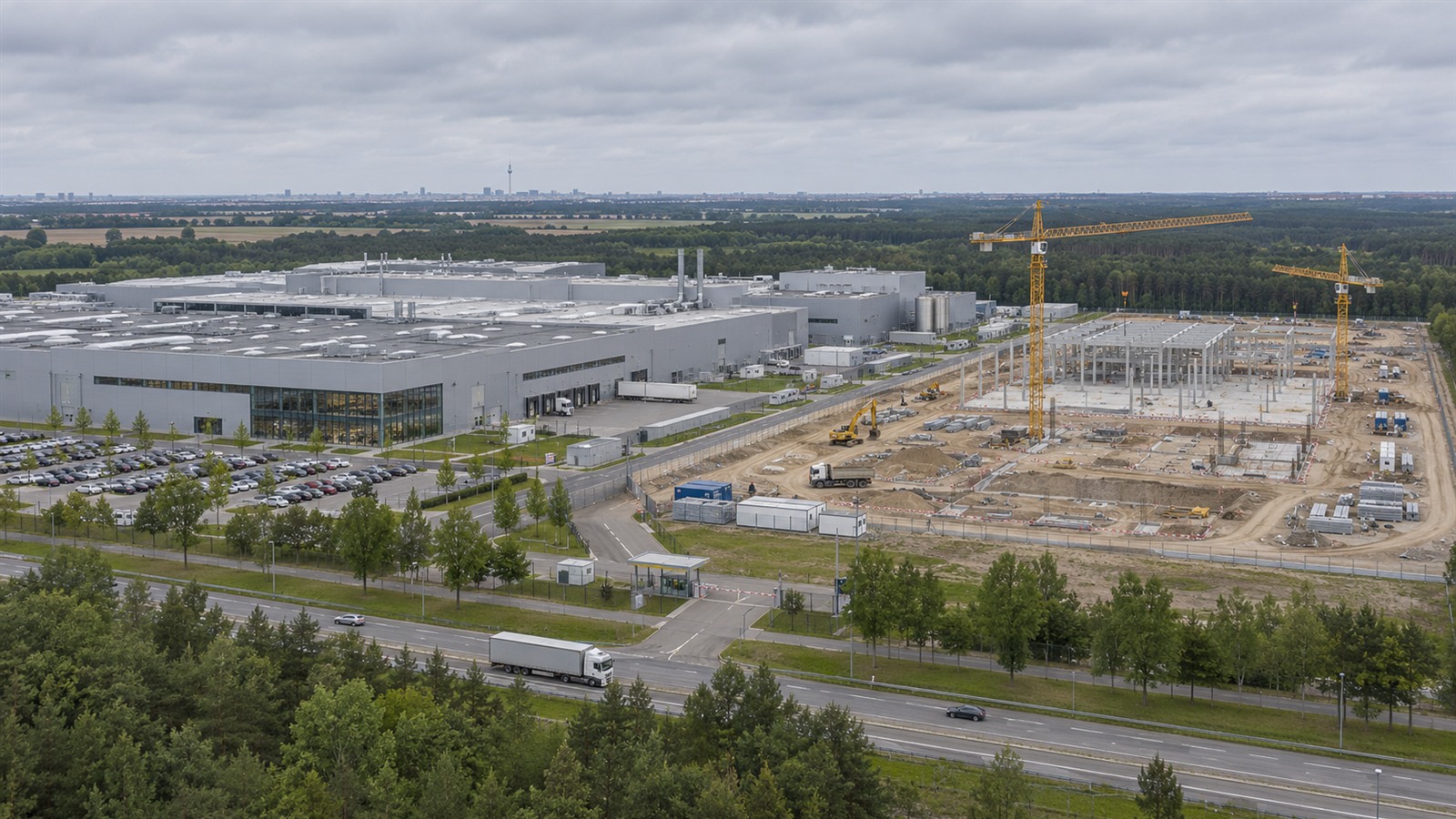
Tesla’s expansion plans for Grünheide combine a long-term capacity outlook with an ongoing manufacturing business. A possible second large hall therefore needs to be assessed differently from actual output. Crucially, Tesla reports record production at the site in the third quarter of 2026, while the next expansion phase still depends on further documentation and approvals.
Assessing Gigafactory Berlin-Brandenburg requires separating four levels: long-term planning, regulatory approval, installed capacity and actual production. These measures can move in different directions at the same time. This overview brings together the latest company disclosures, the published permitting background and regional reporting. Updated: 4 November 2026.
A new Tesla hall in Grünheide: what has been reported
rbb reports around 536,000 square metres for the proposed hall, a possible application in December 2026 and a possible construction start in 2027. Tesla did not commit to an application date or further timetable in its response to the broadcaster. Source: rbb on the proposed additional production hall.
According to the same investigation, despite the larger overall area, the manufacturing space is comparable to the existing hall; other areas are initially intended for storage and logistics. Building size and dedicated manufacturing area are therefore different measures.
One million vehicles: long-term planning rather than current output
Brandenburg’s environment ministry documented the intended expansion to one million vehicles back in December 2024. The State Environment Agency issued the first partial permit on 15 October 2024. The overall project is to be handled through several partial approval stages. That publication describes an expansion path, rather than proving that this volume can already be produced annually. Source: Brandenburg on the first partial permit for Tesla’s expansion.
This distinction matters economically. A long-term plan creates a prospect, but not completed facilities. Approval, in turn, does not replace construction, commissioning and stable operation. Each stage answers a different question. Directly comparing numbers from different stages can easily create an apparent contradiction.
Tesla reports record Berlin production in the third quarter of 2026
In its quarterly update published on 21 October, Tesla reports record production at Gigafactory Berlin. It lists installed annual Model Y capacity at the site as more than 375,000 vehicles. This section does not give an exact Berlin quarterly output figure. Global Tesla production must therefore not be read as Grünheide’s site output. Source: Tesla, third-quarter 2026 update (PDF).
The same update lists Berlin 4680 battery-cell manufacturing as under construction. Tesla also describes expanding battery-pack capacity at the site as an important infrastructure project. Battery cells, battery packs and complete vehicles are different production stages. Progress in one does not automatically establish completion of the others.
These current disclosures broaden the picture beyond a purely historical annual figure. A weaker earlier year and a subsequent production record can both be true. Assessing a trend requires comparable periods and clear definitions. Without them, individual figures cannot reliably establish the overall future direction.
Capacity and utilisation: which calculation makes sense?
Capacity describes potential output under certain conditions. Actual production also depends on materials, staff, equipment availability, changeovers and demand. A factory therefore need not use all its installed capacity in every period. A gap may have different causes that cannot be identified from one metric alone.
A transparent illustrative calculation helps distinguish the concepts: if an arbitrary plant with annual capacity of 400,000 vehicles actually produced 240,000, calculated utilisation would be 60 per cent. This is not a calculation for Tesla Grünheide. Before making a real calculation, it would be necessary to check whether both figures use the same capacity definition, time period and product scope.
Nor should one week’s output simply be multiplied by 52 and presented as a guaranteed annual total. Maintenance, factory holidays and product-range changes can affect the year. A temporary peak and a sustainable average are different measures. For suppliers, reliably planned volumes are particularly important.
Why storage and logistics are part of the expansion decision
A large car factory needs more than assembly equipment. Parts must arrive, be inspected, made available and fed into the correct sequence. Finished products also require space and coordinated transport routes. Additional logistics space can therefore be an industrial objective in its own right and should not merely be seen as unused production space.
The economic impact depends on the existing bottleneck. If material supply or internal routes hinder operations, better organisation can help without every additional area directly assembling vehicles. Conversely, more warehouse space alone does not create customer demand. The actual benefit must be measured across the site’s entire process.
Regional service providers may consequently find opportunities beyond vehicle output alone. Maintenance, building services, transport and operational supplies also form part of the site. Which services are actually awarded depends on specific tenders and agreements. An expansion announcement is not yet an order for an individual company.
Water and energy must match site development
rbb also mentions a planned substation and expanded wastewater treatment. Infrastructure is as relevant to a site as the building itself. Its economic assessment requires considering subsequent operating conditions.
A careful assessment therefore separates demand, technical planning and verifiable implementation. This applies to water availability as well as energy supply and waste management. General statements about circular systems or efficiency do not replace a complete site balance. Without the relevant documentation, precise claims about future consumption or reductions would be provisional.
What employees and suppliers can infer from the plans
More space does not automatically mean a particular number of additional jobs. Staffing requirements depend on tasks, shift patterns and automation. Older long-term employment figures should therefore not automatically be treated as current hiring commitments. Specific vacancies and dated company disclosures with a clear scope provide firmer evidence.
For suppliers, the difference between long-term expansion and short-term call-offs is especially important. They often have to finance materials and staff before customer payments arrive. Investment decisions therefore need binding volumes and agreed procedures for delays. A large potential final expansion does not replace these commercial safeguards.
Which next steps will really matter for Grünheide?
Submitted documents, new permits, a documented construction start and subsequent commissioning are separate milestones to watch. Meanwhile, developments at the existing plant remain relevant. Both levels should be considered together without confusing them. Progress in current production can complement long-term expansion, but does not prove that expansion is complete.
Grünheide thus illustrates how much industrial planning lies behind an apparently simple report about a hall. A sound assessment connects current production, realistic capacity and necessary infrastructure. Our article on Opel, Stellantis and Leapmotor in Europe explains how other manufacturers combine existing plants with new partners.
FAQ: Tesla’s expansion in Grünheide
Select a question to open the answer.
Does Grünheide already produce one million vehicles a year?
One million is a long-term expansion target. Tesla’s October 2026 quarterly update lists installed annual Model Y capacity of more than 375,000. Actual production and capacity must be distinguished.
Is all the planned hall space new manufacturing space?
No. rbb also describes storage and logistics areas. Building size is not a direct measure of additional vehicle capacity.
Has a 2027 construction start been firmly confirmed?
According to rbb, 2027 is a possible date. Tesla’s statement reproduced there contains no binding commitment to that timetable.